
IEA: UAE to Lead Solar Per Capita as India Hits 530 GW by 2030
Middle East and India emerge as key drivers in IEA's global solar outlook through 2031.
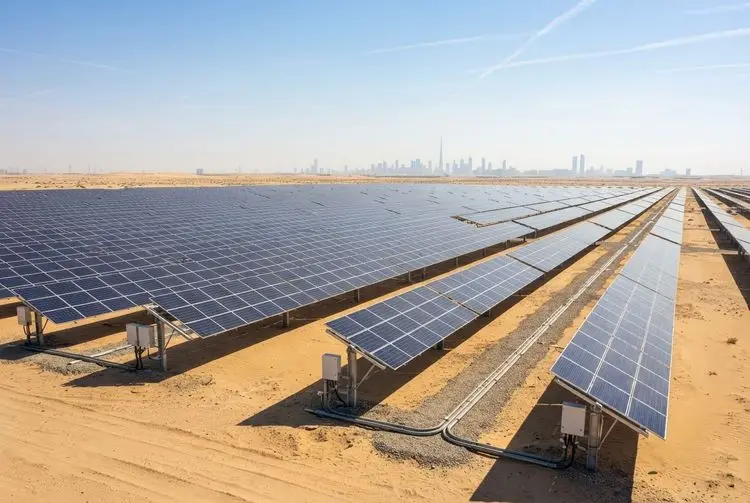
The International Energy Agency's Renewables 2026 report, released in November, projects the United Arab Emirates will become the world's largest producer of solar electricity per capita by 2031, while India's renewable capacity is set to reach approximately 530 GW by 2030. The findings signal a structural shift in global solar deployment, with the Middle East and India taking center stage.
According to the IEA, the UAE will generate over 4,000 kilowatt-hours of solar electricity per person by 2031. That places the country ahead of Australia (second), Oman (third), Bulgaria (fourth), and Qatar (fifth) in the global per-capita ranking. Greece, Austria, Spain, China, and Chile round out the top ten. All ten countries are expected to produce at least 2,000 kWh per person, well above the projected global average of approximately 800 kWh.
The IEA noted persistent disparities in deployment rates and access to solar generation. Leading countries will generate multiple times the global average per-capita solar output, underscoring uneven adoption patterns worldwide.
Middle East triples renewable capacity
The IEA forecasts that the Middle East will triple its renewable energy capacity through 2031, describing the trajectory as a structural step-change in the region's energy market. Saudi Arabia, the Arab world's largest economy, is expected to boost its renewable expansion fivefold, followed by the UAE. The agency attributes the region's growing role to strong policy support and the development of renewable energy markets.
At September's Middle East Energy summit, UAE Minister of Energy and Infrastructure Suhail bin Mohammed Al Mazrouei announced that the country had raised its clean energy target — covering both renewable and nuclear power — to 35 percent by 2030-2031. He stated that achieving the target would require new projects, stronger competition, and greater opportunities for private-sector participation in electricity generation. The minister also said that round-the-clock solar can compete with gas, highlighting the economic viability of solar-plus-storage solutions.
The UAE has continued to champion renewable energy as part of its economic diversification strategy. According to Gulf News, the country's renewable energy capacity has grown more than 6,000 percent in 10 years.
India's energy security-driven solar boom
The IEA separately forecast on November 3 that India's renewable power capacity will reach approximately 530 GW by 2030, with solar PV accounting for more than 80 percent of that growth. The India Renewable Energy Market Report 2026 was launched at the Bharat Renewable Energy Summit in New Delhi.
India's renewable capacity is expected to exceed 300 GW in the fourth quarter of 2026 — almost four times the level a decade earlier — with solar alone topping 350 GW by 2030 (measured in alternating current). The IEA frames this expansion primarily as an energy security story, emphasizing reduced coal and gas import bills amid global energy market uncertainty.
Renewable electricity cut India's coal and gas import bills by more than $100 billion between 2011 and 2025. Cumulative savings are expected to more than double by 2030. Without solar, wind, and bioenergy built since 2010, coal imports in 2025 would have been approximately 110 million tonnes higher. List.solar calculated that this represents more than $6.6 billion a year of avoided coal and gas imports, on average, over 2011-2025.
"India's renewables expansion is delivering major benefits for its energy security at a time of heightened uncertainty in global energy markets," said IEA Executive Director Fatih Birol.
India added a record 44.61 GW of solar in the fiscal year to March 2026, nearly double the prior year's total, according to the Ministry of New and Renewable Energy. The country now has approximately 225 GW of annual solar module manufacturing capacity as of September 2026, making it the world's second-largest producer.
Utility-scale solar PV levelised cost in India stands at $30-35/MWh, the world's second lowest. Additionally, 15 GW of hybrid renewable projects were auctioned in 2025 — the world's largest volume — and more than 100 GW of distributed solar for self-consumption is expected by 2030, triple today's level.
To reach 530 GW from 300 GW, India needs approximately 57 GW of renewables per year over 2027-2030, according to a list.solar calculation. Variable renewables should supply about 26 percent of India's power by 2030, up from about 14 percent. The IEA noted that faster grid, storage, and flexibility investment, healthier utilities, and fewer delays could lift 2026-2030 deployment by more than 20 percent. India is on track for its 500-GW non-fossil capacity target for 2030.
The PM Surya Ghar Muft Bijli Yojana scheme is accelerating residential rooftop installations, while corporate power purchase agreements should underpin about 20 percent of utility-scale solar and wind additions by 2030.
Global outlook and persistent gaps
Solar power is expected to account for more than three-quarters of the growth in renewable electricity capacity worldwide. Total global renewable capacity is projected to increase by nearly 85 percent by 2031. The global renewables market capacity is projected to reach nearly 4,800 GW between 2026 and 2031, representing a 57 percent jump compared to the previous six years. China is expected to remain the top renewables market, with India rising to second place.
The forecast for emerging and developing economies was raised by almost 20 percent compared with the IEA's Renewables report a year ago, driven by new ambitions, energy security benefits, supportive policies, and the growing competitiveness of wind and solar PV.
Despite the rapid growth, the IEA acknowledged persistent disparities in solar deployment and access. While the top ten countries will generate at least 2,000 kWh per person, the global average remains around 800 kWh — a gap that highlights uneven adoption patterns across regions.
For solar industry professionals and investors, the IEA's Renewables 2026 report signals both opportunity and the need to address structural barriers to deployment, including grid investment, storage integration, and private-sector participation.