
Solar Projects Surge Globally as Paris Agreement Temperature Target Slips
New utility-scale solar and CSP plants deliver cuts while climate diplomacy falls short.
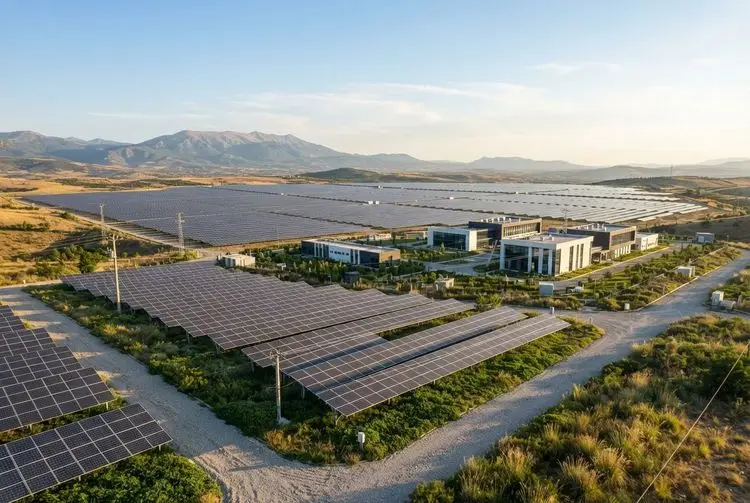
Solar energy deployment continues to accelerate across multiple continents, with major new projects in Türkiye, China and the UAE delivering measurable emissions reductions. Yet a decade after the Paris Agreement was signed, its central goal of limiting global heating to 1.5°C above pre-industrial levels has been missed, highlighting a growing gap between on-the-ground progress and international climate diplomacy.
Aselsan powers production entirely from solar
Turkish defense company Aselsan has commissioned two new solar power plants that will cover all of its production energy needs from renewable sources. The facilities are expected to prevent roughly 121,000 metric tons of CO2 emissions annually, equivalent to the absorption capacity of about 4 million trees per year.
The projects mark the first deployment of Aselsan's domestically developed PULSAR inverters, which the company designed and owns the software rights to. General Manager Ahmet Akyol told Anadolu Agency that the plants will support the sustainable economy while lowering energy costs. "We will meet all of our energy needs from renewable sources while reducing our energy costs and carbon footprint," Akyol said.
Aselsan, one of Europe's fastest-growing defense companies with over 25% average annual growth and $3 billion in ongoing investment, aims to maintain its top position in the Sustainability Index. It was also the first organization in Türkiye to receive the Blue Water Efficiency Certificate.
China connects sixth molten salt tower CSP plant
In China's Xinjiang region, the Luneng Fukang 100,000 kW molten salt tower concentrated solar power (CSP) energy storage project was connected to the grid on October 30, 2026. According to State Grid Xinjiang Electric Power Co., this is the sixth molten salt tower CSP station in the region, signaling that the technology has moved from demonstration phase to batch deployment.
The project operates in a "CSP + PV" combined mode alongside 900,000 kW of photovoltaic capacity. During the day, PV carries the main output, while the CSP unit stores heat in molten salt and continues generating after sunset or when PV output declines, also providing peak shaving. The CSP portion generates about 120 million kWh per year on average, saving roughly 40,000 metric tons of standard coal and reducing CO2 emissions by about 140,000 metric tons annually.
The overall installed capacity reaches the million-kilowatt level, making CSP, PV and thermal storage a dispatchable power supply combination. The project's long-duration energy storage attributes help smooth output curves, reduce PV curtailment and provide a reference for multi-energy complementary power systems.
UAE pushes toward net-zero with 1.5 GW solar plant
The 1.5-GW Abu Dhabi PV3 Al Ajban solar project, developed with Chinese company PowerChina, is nearing grid connection. Once completed, the plant is expected to generate 4.4 billion kWh annually—enough for about 160,000 households—and cut CO2 emissions by around 2.4 million metric tons per year. Spanning about 20 square kilometers, it is PowerChina's first large-scale solar project in the UAE.
Chinese-made photovoltaic installation robots have been deployed at the site, bringing greater automation to module installation. The UAE has committed to net-zero greenhouse gas emissions by 2050 and is accelerating renewable energy development.
Shanghai Electric built phase four of the Mohammed bin Rashid Al Maktoum Solar Park (700 MW CSP plus 250 MW PV) and participated in the 900-MW fifth phase. Together, the two projects cut about 2.78 million tons of emissions annually. PowerChina also completed the UAE Wind Program, the country's first utility-scale wind power project, in 2023. China-UAE cooperation is moving beyond stand-alone solar projects to integrated photovoltaic and large-scale energy storage projects.
Francesco La Camera, director-general of IRENA, said China has made important contributions to the global energy transition by advancing technology and lowering clean energy equipment costs.
Paris Agreement: missed target, enduring framework
A decade after the Paris treaty, its key temperature goal has been missed. Temperatures have exceeded the 1.5°C threshold for two years, and the UN estimates 1.7-1.8°C of heating. The rate of temperature rise has accelerated from 0.2°C per decade in 2015 to 0.4°C per decade today.
Critics point to convoluted negotiations, a consensus rule that gives petrostates like Saudi Arabia and Russia veto power, and the US withdrawal under President Trump. Even supportive developed countries have failed to produce convincing plans: Australia has set no end to fossil fuel exports, Turkey plans to increase carbon output, the UK is opening a gasfield, Germany dropped EV sales targets and scrapped a renewable heating law, and rich countries are reducing climate finance.
Yet experts insist Paris remains vital. "Paris is all we have," said Johan Rockström, director of the Potsdam Institute for Climate Impact Research, acknowledging that following a path to 2.6°C-3°C within the Paris framework "cannot be considered as anything but a global failure." Juan Carlos Monterrey, former climate envoy for Panama, said, "Paris is our moral compass. It has told us where we should go."
The agreement has triggered real-world transformation. Rooftop solar makes up about a quarter of Pakistan's electricity use, and Chinese EVs account for more than 40% of Vietnam's car sales. Claudio Angelo of Observatório do Clima remarked, "The solar panels on my roof and the BYD Dolphin my neighbour drives are exhibit one and exhibit two of Paris's success."
Looking ahead, Cop31—held in Turkey but presided over by Australia—may advance electrification targets. A potential goal of deriving 35% of final energy use from electricity by 2035, up from 23% today, is being discussed. Adair Turner, co-chair of the Energy Transitions Commission, said, "Electrification is the single most important thing you have to do [to reach net zero emissions]."
After Cop30's failure to produce a strong fossil fuel phase-out statement, nearly 60 countries met in Colombia in April and agreed to draw up their own national roadmaps; France, Germany and the Netherlands have done so. Cutting methane by 40% could hold down temperatures by about 0.3°C in the next decade.
Practical progress amid policy shortfalls
The week's developments illustrate a dual reality: solar and storage projects are delivering measurable emissions reductions and economic benefits, while international climate diplomacy struggles to meet its own targets. Renewable energy deployment is accelerating, but the pace of emissions cuts remains insufficient to avert dangerous warming.
As Aselsan's Akyol put it, "While developing our production capacity and technology infrastructure, we keep energy efficiency among our priorities." That sentiment—practical progress amid policy shortfalls—characterizes the current state of the global energy transition.