
Tesla's $10.1B Solar Cell Plant Faces Cost and Capital Hurdles
Tesla confirms Project Crystal Sun in Texas while Ember data shows wind cuts firm solar costs 18%.
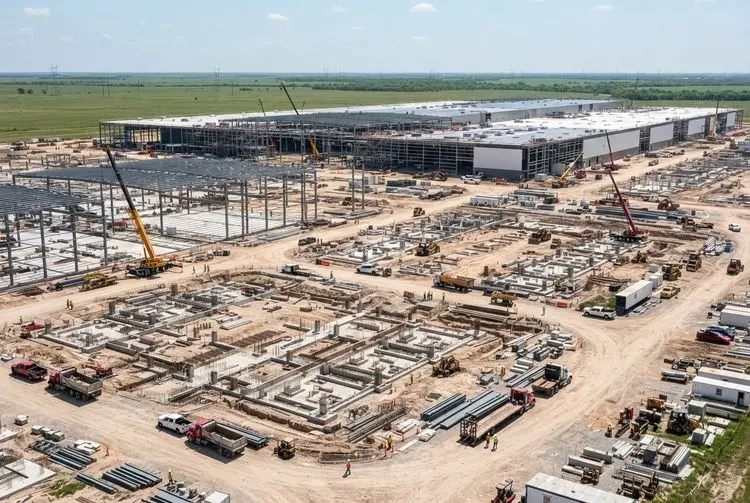
Two developments this week highlight both the promise and the pressure facing the global solar industry: Tesla's confirmation of a $10.1 billion solar cell factory in Texas, and a new analysis from energy think tank Ember showing that pairing wind with solar-plus-battery systems cuts the cost of near-firm renewable power by 18%.
Elon Musk confirmed the name of Tesla's proposed solar cell plant outside Houston as Project Crystal Sun. In a post on X, Musk wrote that solar power "will obviously ultimately round up to 100% of all energy," calling the math "obvious and trivial."
According to Tesla's Texas tax-incentive application, the plant would cost $10.1 billion, with roughly $1.5 billion allocated for land and buildings and $8.6 billion for equipment. The facility would sit on approximately 3,050 acres near Richmond, Texas, with commercial production targeted for the first quarter of 2029. The filing projects 9,712 permanent jobs.
Fort Bend County commissioners approved four incentive agreements by a 4-0 vote on October 22. The Texas Comptroller and the governor's office still must sign off. Tesla is also evaluating other U.S. sites and hopes to select a final location before the end of 2026.
Why Tesla is building its own solar cells
Tesla is moving forward because it cannot keep up with demand. On the October earnings call, Musk said Tesla was "almost sold out of all Megapacks for 2027." Chief Financial Officer Vaibhav Taneja pointed to "extreme demand from data centers" as a key driver. AI campuses need power faster than utilities can add it, and solar panels paired with battery storage are among the fastest ways to deliver that electricity.
Energy storage is currently Tesla's most profitable business. Energy gross margin rose to 33.1% in the third quarter, up from 20.4% in the prior quarter. Taneja attributed much of that jump to tariff refunds and a vendor warranty reimbursement. Across the whole company, Tesla's operating margin over the past year stands at about 4.6%.
Tesla already manufactures lithium iron phosphate (LFP) battery cells in Nevada. Adding its own solar cells would allow the company to sell data centers a complete power package, reducing reliance on outside suppliers.
Financial strain and competing priorities
The $10.1 billion plant would place significant demands on Tesla's budget. The company revised its capital spending plan for this year to about $20 billion and set up the ability to borrow up to $30 billion. Third-quarter free cash flow fell 61.6% year-over-year to $1.5 billion.
Musk said the Austin chip fab alone will need "tens of billions in capital equipment" through early 2028, with long-term costs "probably north of $100 billion." Project Crystal Sun must compete with robotaxis, Optimus robots, and the chip fab for the same capital.
Tesla does have a buffer: $45.4 billion in cash and debt at just 0.1 times equity. However, the stock trades at about 407 times past-year earnings. At $379 per share, the stock is down about 16% this year. At that valuation, investors are already pricing in profits several years out, meaning a late or over-budget factory could hurt the stock.
Solar's global growth trajectory
Global solar generation rose by a record 636 TWh to 2,778 TWh in 2025, according to Ember, covering 75% of electricity demand growth. Even so, solar still provides just 9% of the world's electricity. Musk's "trivial" math assumes solar will capture the remaining share.
Ember: Wind cuts near-firm solar cost by 18%
Separately, Ember published a global analysis on November 16 finding that adding wind to solar farms and batteries cuts the median cost of meeting 90% of round-the-clock electricity demand from $105 to $86 per megawatt-hour — an 18% reduction. Most of the savings come from requiring smaller batteries rather than from generation costs.
Ember ran every region of the world through 10 years of hourly weather data (2015–2024) against a flat baseload, using 2026 prices and a 7% real cost of capital. Uptime is defined as the share of a year's demand met hour by hour by a region's own solar, wind, and batteries — not the share of hours. Ember calls the results a stress test, not a forecast.
Storage is where wind does the most work. In the U.S. and Europe, the battery needed for 90% uptime shrinks from 20 hours of load to 12 when wind is added. In Canada, battery hours drop from 24 to 10; in China, from 18 to 12. Near the equator, wind changes little: India still needs 14 hours.
North of 45°N, wind cuts the median cost of 90% uptime from $164 to $99/MWh. Sunny regions gain less, since solar and batteries already perform well there.
A solar lull week and a wind lull week coincide about once every four years, compared with about four solar lull weeks a year. The median cost of fully firm solar and wind power is $89/MWh, with gas or diesel backup covering remaining hours.
Implications for fossil fuel planning
Ember found that 706 GW of the 845 GW of coal and gas plants in planning sit where firm solar and wind power costs under $100/MWh. The group's June 2025 study found $104/MWh for 97% constant solar supply in Las Vegas.
"The much more interesting question is how cheaply we can make them reliable," said Daan Walter, a principal at Ember.
The study follows a narrower Ember report on wind-solar-battery hybrids in Kazakhstan. Ember has published an interactive Wind + Solar + Battery Atlas showing cost paths falling from $89 to $52/MWh by 2050.
Consensus and divergence
Both sources agree that solar and storage are increasingly cost-competitive and that demand — particularly from data centers — is surging. Tesla's move reflects confidence in solar's long-term dominance, while Ember's analysis emphasizes that reliability, not just generation cost, is the key metric.
The perspectives diverge on risk. The Tesla coverage highlights financial strain, high valuation, and competing capital demands. Ember's report is more optimistic, framing firm renewable power as already cheaper than planned fossil fuel plants in many regions.
For industry professionals, the takeaway is twofold: major manufacturers are betting billions on vertically integrated solar and storage, while analysts are refining the economics of making renewables reliable at scale.