
Duke Energy Florida Files for 300 MW Solar Portfolio Across Four Sites
Four new solar centers in Orange and Sumter counties target $1 billion in customer savings.
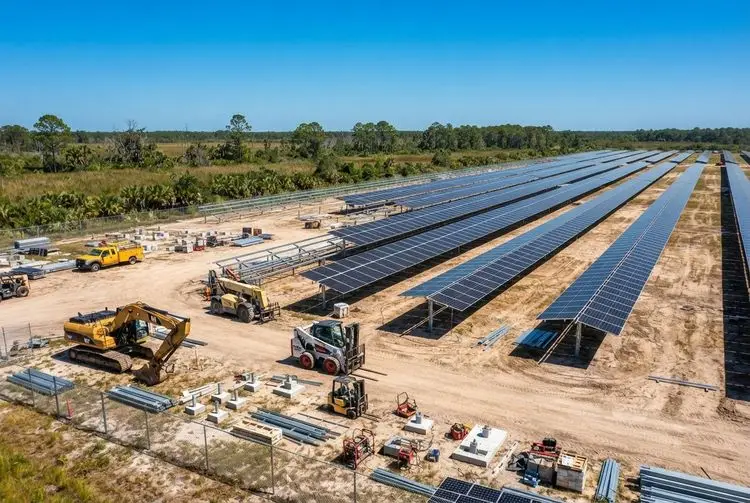
Duke Energy Florida has submitted regulatory applications to the Florida Public Service Commission for four new solar energy centers totaling 300 MW of combined capacity. The utility projects the portfolio will deliver approximately $1 billion in customer savings over a 30-year operational life, according to filings reported by PV Magazine USA and Energies Media.
The four projects — the Nova, Bull Creek, Hogeye and Wewahootee Renewable Energy Centers — will be located across Orange and Sumter counties. Construction is staggered across 2027 and 2028, with all sites expected to reach completion by mid-2028.
Project Timeline and Locations
The Nova Renewable Energy Center in Orange County is scheduled to begin construction in January 2027 and reach completion in February 2028. The Bull Creek Renewable Energy Center, also in Orange County, will start construction in March 2027 and finish in April 2028.
The Hogeye Renewable Energy Center in Sumter County begins construction in May 2027 with completion expected in May 2028. The Wewahootee Renewable Energy Center in Orange County also starts construction in May 2027, with completion anticipated in June 2028.
Customer Savings and Fuel Displacement
Duke Energy estimates each individual solar site will save customers approximately $250 million in fuel costs over its operating life by reducing reliance on natural gas, oil and coal. The zero-emission electricity generated at each site displaces roughly 1.1 million cubic feet of natural gas, 12,000 barrels of fuel oil and 9,000 tons of coal annually, according to PV Magazine USA.
The filings arrive as Duke Energy Florida pursues a parallel rate mitigation strategy involving its battery storage portfolio. The utility is accelerating delivery of federal investment tax credits tied to the Powerline Battery Energy Storage System in Citrus County. This tax credit acceleration is designed to offset a scheduled base rate increase and help lower customer bills in 2027.
Tax Credit Strategy
Duke Energy Florida can use the Inflation Reduction Act to transfer an estimated $75 million in production tax credits to customers per year, Energies Media reports. That translates to a monthly bill reduction of at least $2.50 per 1,000 kilowatt-hours of electricity used, a figure that will increase as more solar sites come online.
Existing Florida Operations
The utility currently owns, operates and maintains 25 solar energy sites across Florida totaling 1,850 MW. Each existing site can power approximately 15,000 homes. The new 300 MW portfolio will expand that footprint by roughly 16 percent.
Duke Energy is a Fortune 150 company headquartered in Charlotte, North Carolina, and one of the largest energy holding companies in the United States. Its electric utilities serve 8.7 million customers across six states: North Carolina, South Carolina, Florida, Indiana, Ohio and Kentucky. The company owns 55,700 MW of total energy capacity.
Florida Solar Market Context
Florida ranks third in the United States for total installed solar capacity, according to the Solar Energy Industries Association (SEIA) as cited by PV Magazine USA. The state has 22.5 GW of operational solar that powers over 2.7 million homes. Florida's solar market accounts for $33.7 billion in capital investment and supports 14,303 solar jobs across 473 local companies. An additional 12,850 MW of solar capacity is projected over the next five years.
Energies Media reports slightly different figures, noting Florida ranks third in solar power generation with 30,131 GWh produced, powering more than 2.4 million homes through over 286,000 installations. The discrepancies reflect different measurement methodologies and reporting periods between sources.
Florida is the third-fastest-growing state in the nation, which is driving rising electricity demand that the new solar capacity will help meet.
Regulatory Path
The filings with the Florida Public Service Commission represent the formal regulatory step required before construction can begin. The commission will review the applications, and approval would allow Duke Energy Florida to proceed with its planned construction timelines. The utility has not announced any anticipated obstacles to regulatory approval.
The four new solar energy centers represent a continuation of Duke Energy Florida's investment in renewable energy infrastructure and its strategy to leverage federal tax incentives to offset customer rate pressures while expanding clean energy generation capacity.