
Tibet's 10,000 GW solar potential drives China's carbon neutrality push
Tibet has emerged as China's primary renewable energy base, with solar potential reaching 10,000 GW.
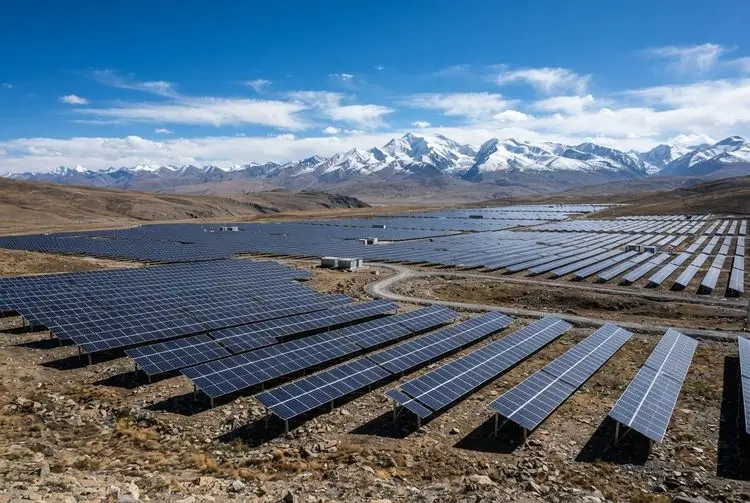
China's ambitious carbon goals, announced by President Xi Jinping in September 2020, are reshaping the country's energy landscape. The targets — carbon peaking before 2030 and carbon neutrality by 2060 — have pushed Tibet into the spotlight as the nation's primary renewable energy base.
Tibet's solar potential could reach 10,000 GW, a figure that dwarfs most national power grids worldwide. This vast resource is now being tapped through a series of large-scale projects that combine solar generation with long-distance transmission infrastructure.
China already dominates global solar and wind equipment supply chains. The country supplies approximately 70% of the world's wind equipment and 80% of global solar PV modules, according to industry data cited in the China Electric Power Planning and Engineering Institute's 'China Energy Development 2026' report.
Massive solar farms reshape the Tibetan Plateau
The Talatan solar farm in Gonghe County, Qinghai province, now generates 21 GW. The Gonghe Photovoltaic Park, built between 2012 and 2015 with an operating life of 20 to 30 years, is considered the world's largest PV station. State media reports describe the facility as several times larger than Manhattan.
Dr. Y. Nithiyanandam of the Takshashila Institution conducted a satellite imagery study published in June 2025, examining solar facilities near Shigatse Peace Airport. The research highlights the rapid expansion of solar infrastructure across the Tibetan Autonomous Region.
State media presents these solar farms as examples of ecological modernization. Agrivoltaic practices at the Gonghe site have reportedly restored grasslands, combining energy generation with environmental rehabilitation. The Photovoltaic Poverty Alleviation Program has been described as a poverty-reducing model.
A world's highest-altitude parabolic trough solar facility is also under construction, pushing solar technology into extreme high-elevation environments where thin air and intense solar radiation present both challenges and opportunities.
Transmission lines connect Tibet to industrial centers
An ultra-high-power transmission line from Tibet to Guangdong is scheduled for completion by 2029. The line will carry more than 43 billion kWh per year from the Tibetan Autonomous Region — roughly half the annual output of the Three Gorges Dam.
This electricity will feed Guangdong and Shenzhen, China's industrial powerhouses. The transmission project is part of the 'Eastern Data and Western Computing' megaproject launched in 2022, which routes clean energy from western regions to data centers and factories in the east.
The Yajiang-1 computing hub in Lhoka is under development as part of this strategy, positioning Tibet not only as an energy exporter but also as a site for energy-intensive computing infrastructure.
Strategic minerals underpin the energy transition
China's five-year plan outlines 300 energy bases, and Tibet's role extends beyond solar generation. The region holds abundant copper reserves, a metal vital for power transmission lines, grid infrastructure and solar equipment manufacturing.
More than 20 million metric tons of copper have been discovered in Tibet since 2021. The Yulong mine produced 152,000 metric tons of copper in 2025 alone. Other major operations include the Gyama and Qulong mines.
At least nine strategic minerals in Tibet rank among the top three in China by reserves. The region ranks first nationally for antimony and chromium. Companies including Xizang Zhihui Mining and Zhaojin Nonferrous are planning mineral projects in the region.
What this means for the solar industry
For solar industry professionals, Tibet's emergence as a renewable energy hub signals sustained demand for PV modules, inverters and balance-of-system components at extreme altitudes. The combination of solar farms, transmission infrastructure and mineral extraction creates a vertically integrated clean energy supply chain.
The 10,000 GW solar potential figure, while theoretical, indicates that China views Tibet as a long-term strategic asset for meeting its 2060 carbon neutrality target. The transmission line to Guangdong, carrying roughly half the output of the world's largest hydropower station, demonstrates the scale of infrastructure required to integrate remote solar generation into industrial demand centers.
China's dominance in solar PV module manufacturing — 80% of global supply — means that developments in Tibet will have ripple effects across global solar equipment markets. Installers and investors should monitor how high-altitude deployment experience in Tibet translates into technology improvements and cost reductions for the broader industry.