
U.S. solar manufacturing enters Third Wave as 100 GW module capacity arrives
Cumulative module capacity hits 100 GW in Q2 2026, but upstream gaps threaten long-term competitiveness.
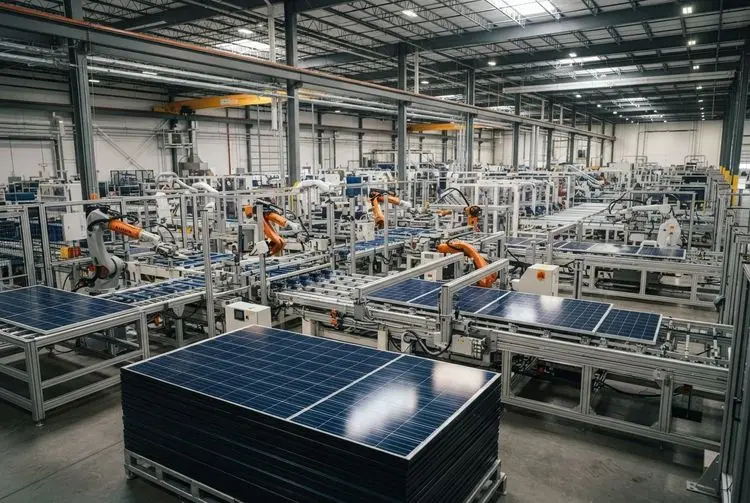
The United States solar manufacturing sector has reached a critical inflection point, with cumulative module capacity crossing 100 GW in the second quarter of 2026. Of that total, 75.3 GW is currently active and operational, according to data compiled from industry sources including RCT Solutions, NREL and the Department of Energy Solar Energy Technologies Office.
The milestone marks the clearest signal yet that the Inflation Reduction Act's manufacturing incentives are driving real physical buildout. Post-IRA capital expenditure across the U.S. solar supply chain is projected to reach $12.2 billion by the end of 2026, with roughly 60 percent of that spending going into buildings and 40 percent into production equipment.
Yet the headline capacity figure masks a more complex reality. While module assembly lines are scaling rapidly, the domestic supply of upstream components — particularly cells, wafers and polysilicon — remains a structural vulnerability.
The Third Wave arrives
Dr. Charlie Gay, director at the Greenstar Foundation, described the current moment as a fundamental shift in the industry's trajectory. "We are now entering the third wave of photovoltaics," Gay said.
The first wave, from the mid-1970s through the 1980s, was driven by oil embargoes and focused on off-grid applications. The second wave, spanning the 1990s to the 2010s, relied on feed-in tariffs and grid-tied installations. The third wave, Gay argues, represents a convergence of solar, battery storage, electric vehicles and artificial intelligence, transforming solar panels into intelligent distributed assets at the grid edge.
Manufacturers now face a narrow window to build competitive, integrated operations before key IRA provisions begin to phase out. Sections 45X, 45Y and 48E are scheduled to wind down between 2030 and 2032. "Policy incentives buy time, but they do not guarantee long-term immunity from market realities," Gay said.
Capacity versus capability
Utilization rates across the emerging manufacturing base reveal a sharp divide between mature and early-stage facilities. Established module factories are running at 70 to 80 percent utilization, while plants still in ramp-up phase operate at just 15 to 20 percent. That gap underscores the difference between announcing capacity and achieving reliable, cost-competitive production.
Dr. Markus Beck, head of business development North America at RCT Solutions, cautioned against focusing solely on gigawatt-scale announcements. "True domestic progress can only be measured by moving past simple capacity figures and building a cohesive, functional manufacturing ecosystem," Beck said.
Cell production remains the most critical bottleneck. Currently, 10.6 GW of cell manufacturing capacity is operational in the United States, with another 19.1 GW under construction. That pipeline is encouraging, but it still falls far short of the module assembly capacity already in place, meaning most U.S. module makers remain dependent on imported cells.
Upstream integration and cost pressure
U.S. module costs remain higher than international benchmarks, a disadvantage that policy protections can only temporarily offset. The industry must drive down unit economics to achieve structural cost parity before the IRA provisions expire.
Three priorities have emerged for manufacturers: balancing capacity growth with genuine capability, integrating upstream into cell and wafer production, and implementing advanced yield management techniques.
On the technology front, back-contact cell architectures are gaining attention because they enable automated pick-and-place surface-mount assembly, reducing labor costs and improving throughput. Eliminating silver paste in favor of copper or aluminum metallization offers another path to cost reduction.
Global context and new sales channels
At the global level, polysilicon supply is abundant. Total worldwide capacity stands at 3.5 million tons, with top-tier production capability estimated at roughly 2 million tons — enough to support approximately 1 TW of annual module output. Global annual solar demand is scaling toward 1,000 TWh, a trajectory that continues to pull the entire supply chain forward.
Manufacturers are also exploring non-traditional sales channels to diversify revenue. Direct-to-consumer balcony solar systems equipped with smart modems represent one emerging market segment that bypasses conventional project development cycles.
The transition from policy-stimulated announcements to physical production will define the U.S. solar manufacturing landscape through 2027. The 100 GW module milestone is real, but the industry's long-term health depends on whether it can close the upstream gap, improve utilization rates and achieve cost competitiveness before the policy clock runs out.