
1.4 MW solar portfolio powers Connecticut veterans facilities
Two solar arrays at a Connecticut DVA campus will save $2.2 million over 20 years.
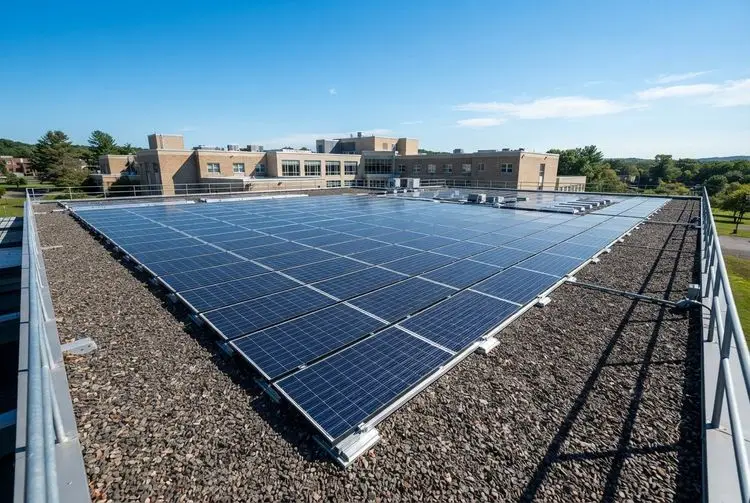
Two solar photovoltaic installations totaling 1.404 MW DC have been completed at the Connecticut Department of Veterans Affairs (DVA) main campus and its skilled nursing facility in Rocky Hill, Connecticut. The projects were developed under the Connecticut Green Bank's Solar Marketplace Assistance Program Plus (Solar MAP+), which is designed to accelerate solar deployment for state agencies, municipalities, affordable housing providers and schools.
The arrays are projected to generate approximately 1.84 million kWh annually. The main campus installation, rated at 604.8 kW DC, will produce an estimated 784,914 kWh per year and offset 35% of the facility's electricity load. The larger installation at the skilled nursing facility, at 799.2 kW DC, is expected to generate 1.059 million kWh annually and offset 85% of that facility's grid consumption.
Projected savings and operational structure
Over a 20-year operational lifecycle, the combined installations are expected to deliver $2.2 million in energy cost savings, averaging roughly $100,000 per year. The main campus accounts for $665,373 of that total, while the skilled nursing facility contributes $1.538 million.
Ron Welch, Brigadier General, U.S. Army (Ret.) and Commissioner of the Department of Veterans Affairs, said: "This remarkable solar field will power most of our Veteran Healthcare Center and part of our Residential Program, generating estimated savings of $100,000 per year and $2.2 million over the next 20 years."
Greenskies Clean Energy served as the engineering, procurement and construction (EPC) contractor for both installations. Kearsarge Energy L.P. will handle long-term operations and maintenance (O&M) and ownership of the systems. Kearsarge partnered with the Connecticut Green Bank on this project and nine other state portfolio projects under the Solar MAP+ framework.
Policy context and program design
The Solar MAP+ program is a key instrument in Connecticut's strategy to expand distributed solar generation across public-sector facilities. By aggregating multiple projects and leveraging a standardized procurement model, the program aims to reduce soft costs and shorten development timelines for state agencies, municipalities and schools.
The projects also support the GreenerGov CT initiative, which is co-chaired by the Department of Administrative Services (DAS), the Department of Energy and Environmental Protection (DEEP), and the Office of Policy & Management (OPM). GreenerGov CT targets reductions in greenhouse gas emissions across state government operations.
Dan O'Brien, Chief Commercial Officer at Greenskies Clean Energy, said: "Projects like this show what's possible when public and private partners, along with strong and stable incentive programs, work together: long-term clean energy and savings for the buildings people rely on every day."
What the project means for the sector
For solar industry professionals, the Rocky Hill installations illustrate several structural trends in the distributed generation market. First, the Solar MAP+ model demonstrates how state-level aggregation programs can create a reliable pipeline of mid-sized commercial and institutional projects — the kind that fall between small residential rooftop jobs and large utility-scale developments. Second, the split between a 35% offset (main campus) and an 85% offset (nursing facility) highlights how site-specific load profiles and roof or land availability drive system sizing, rather than a one-size-fits-all approach.
The involvement of Kearsarge Energy as a long-term owner and O&M provider also reflects the growing prevalence of third-party ownership models in the public-sector solar market. Rather than requiring state agencies to raise upfront capital, these structures allow them to purchase power at a discount to retail rates over a 20-year term, with the developer assuming performance risk.
For investors and installers watching the Connecticut market, the Solar MAP+ program remains a significant demand driver. The state's commitment to reducing greenhouse gas emissions through GreenerGov CT provides a policy backstop that supports continued procurement. Projects that pair meaningful bill savings — in this case, roughly $100,000 per year — with visible public-sector leadership can serve as reference installations that help build momentum for similar efforts in other states.