
Australia faces critical window to build solar PV circular economy
With 40.6 GW installed, Australia must act before 2030 to manage a looming wave of end-of-life panels.
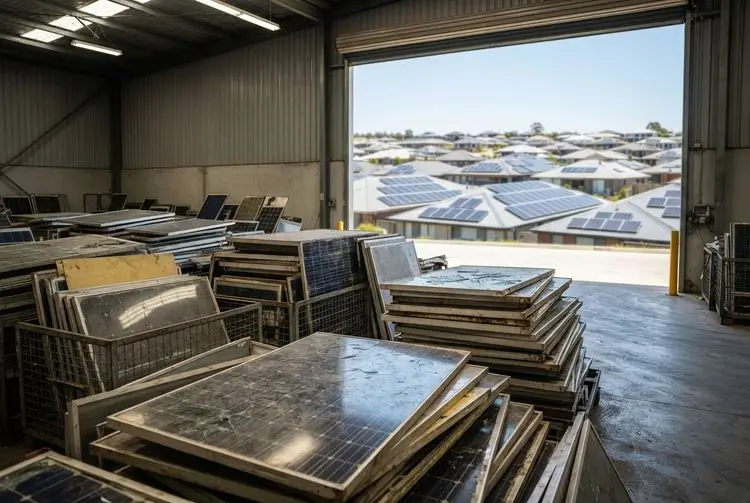
Australia leads the world in per-capita solar PV deployment with 40.6 GW of installed capacity across more than 4 million systems. That success now presents a mounting waste challenge. The country currently generates roughly 40,000 tonnes of end-of-life PV waste annually, a figure that could surge past 100,000 tonnes per year by the early 2030s.
Cumulative PV waste is projected to reach approximately 1.1 million tonnes by 2035 and could double or triple by 2050. The installation spike between 2018 and 2024 will drive a corresponding decommissioning surge starting around 2030, as panels installed during that boom reach the end of their operational life.
The critical window to build a circular economy for solar panels runs from 2025 to 2030. That window closes before the next federal election, expected in late 2027 or early 2028, making policy action time-sensitive.
The scale of the opportunity
Reuse offers far greater value than recycling. A reused panel has 133 times more value than a recycled panel, and between 45% and 65% of decommissioned panels are suitable for reuse. Currently, only about 10% of end-of-life panels are screened for reuse. If reuse were scaled up, recovered panels could raise national PV capacity by up to 17% by 2035.
The average panel is decommissioned after only 12 years of service, well short of its manufactured lifespan of 20 to 25 years. That gap represents both a problem and an opportunity for the secondary panel market.
Recycling costs approximately $28 per panel, while landfill disposal costs $4 to $5 per panel. That cost differential creates an economic distortion that favours disposal over recovery. Recycling also generates 9.2 jobs per 10,000 tonnes of material, compared to 2.8 jobs for landfilling — a 3.3 times employment advantage.
Strategic vulnerability and material value
China dominates more than 80% of all PV manufacturing stages. Australia imports roughly 1 GW of solar panels per year, creating a structural dependency. Raw materials are exported to China and imported back as finished panels, leaving Australia strategically exposed.
The total recoverable material value from end-of-life panels exceeds $1 billion by 2035. Recycled aluminium requires one-twentieth of the energy needed to produce virgin aluminium. Copper recycling efficiency exceeds 90%, and aluminium recovery from panel frames is above 98%. Silicon from recycled panels has 10 times the capacity of graphite when used in battery anodes.
A circular PV economy could deliver 30% to 50% reductions in solar greenhouse gas emissions. Shipping panels generates 30,000 to 100,000 tonnes of CO2 annually.
Infrastructure and economics
A commercial-scale recycling facility with 2,500 tonnes per year processing capacity requires approximately $7.5 million in capital expenditure. Payback periods for baseline facilities range from 7.2 to 8.0 years. Each facility could support between 146 and 335 jobs by 2030.
Metro recycling facilities would handle 5,000 to 10,000 tonnes of annual PV waste. Logistics costs can account for up to 60% of total scheme costs, making jurisdiction-specific logistics models essential — Queensland's needs differ from Victoria's.
The existing recycling infrastructure uses low-technology-readiness-level mechanical methods that downcycle materials. There is no functioning national marketplace for secondary panels, and subsidised downcycling slows the development of genuine high-value circular infrastructure.
Three scenarios for 2040
Modelling by researchers has mapped three infrastructure configurations across five states. In Scenario A, 104 kilotonnes are reused by 2040, 365 kilotonnes are recycled, and 574 kilotonnes remain non-circular. Scenario B sees 209 kilotonnes reused, 470 kilotonnes recycled, and 365 kilotonnes non-circular. Scenario C achieves 313 kilotonnes reused, 574 kilotonnes recycled, and 157 kilotonnes non-circular.
The difference between Scenarios A and C diverts more than 418 kilotonnes from landfill, a 73% drop in cumulative waste by 2040. Between 2041 and 2050, end-of-life panels could supply more than 60% of silver for domestic manufacturing, more than 30% of silicon, and more than 20% of copper and aluminium.
Policy landscape
The circular PV economy aligns with the Future Made in Australia policy framework. The National Solar Panel Recycling Pilot, announced on 16 January 2026, allocated $24.7 million in funding to collect 250,000 panels across 100 collection sites. The pilot was anticipated to start in mid-2026 but was suspended in July 2026 due to a procurement complaint.
In Queensland, the Blue Tribe PV reuse trial running through 2025-2026 found that more than 50% of panels were suitable for reuse. The Queensland Household Solar Panel Recovery Pilot is also underway.
Researchers from the RAND Corporation, Australian PV Institute, University of Technology Sydney's Institute for Sustainable Futures, Blue Tribe Company, Circular PV Alliance, Biosphere Solar, CSIRO, RMIT, UNSW and the Australian Centre for Advanced Photovoltaics have contributed to the evidence base. Key figures include James McGregor, Nick Florin, Hengky Salim and Benjamin Madden.
The Department of Climate Change, Energy, the Environment and Water (DCCEEW), the Australian Renewable Energy Agency (ARENA) and the Solar Sunshot initiative are among the government bodies involved. The Product Stewardship Act and the Net Zero 2050 plan provide the broader policy context.
Five pathways forward
Researchers have identified five pathways to build a circular PV economy: policy reform, market development, technical innovation, logistics optimisation and material recovery. A three-horizons timeline aligns with the Net Zero 2050 plan.
Reuse must be the first priority, with recycling handling what reuse cannot. Returns are achievable with existing technologies — no breakthrough research and development is needed. Social dimensions including community acceptance, justice and First Nations engagement also require attention.
Australia has first-mover innovations in solar PV but lacks a national framework to capture the value of its end-of-life panels. The 2025-2030 window offers a narrow opportunity to build that framework before the decommissioning wave arrives at scale.