
Indonesia's Solar Market: Policy Shifts and Project Pipeline Update
An overview of Indonesia's evolving solar energy landscape and regulatory developments.
Indonesia's solar energy sector is undergoing a period of notable policy recalibration as the government seeks to balance renewable energy targets with domestic manufacturing interests and coal-dependent grid economics. For solar industry professionals tracking Southeast Asia's largest economy, the developments signal both opportunities and headwinds.
The Indonesian government has revised its renewable energy procurement framework, introducing new regulations that aim to accelerate solar deployment while protecting local module manufacturers. Under the updated rules, solar projects must achieve a minimum local content threshold of 40 percent for utility-scale installations, rising to 60 percent for rooftop systems. These requirements apply to both photovoltaic modules and balance-of-system components.
Industry observers note that the local content mandates could constrain project economics, given that domestic module production capacity remains limited. Indonesia currently has around 1.5 GW of annual solar module manufacturing capacity, according to industry estimates, far below the volumes needed to meet the government's target of 4.4 GW of new solar capacity by 2030 under the National Energy Plan.
Project pipeline and pricing dynamics
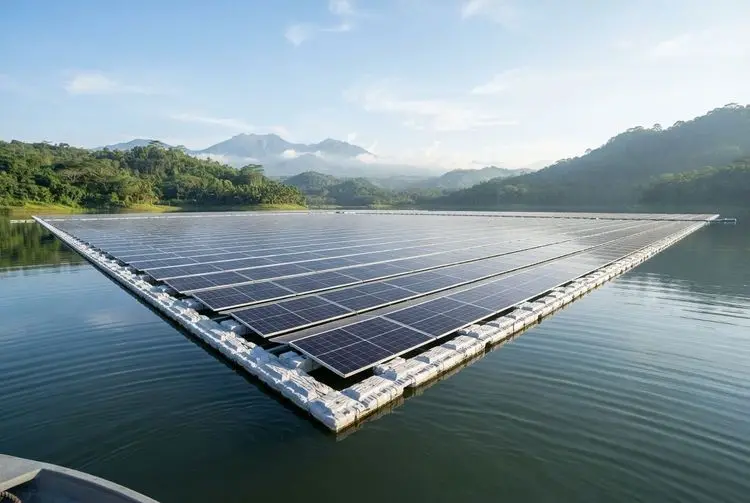
The project pipeline includes several large-scale solar PV developments. The Cirata floating solar project in West Java, a 145 MW facility developed by Masdar and PT PJB, began commercial operations in late 2023 and represents the largest floating solar installation in Southeast Asia. A second phase of the project, adding another 500 MW, is under discussion.
On the pricing front, solar power purchase agreement (PPA) tariffs in Indonesia have declined significantly. Recent tenders for utility-scale solar have seen prices in the range of $0.038 to $0.045 per kWh, down from levels above $0.06 per kWh just a few years ago. These prices are increasingly competitive with coal-fired generation, which has a levelized cost of around $0.045 to $0.055 per kWh for new plants.
However, the state utility Perusahaan Listrik Negara (PLN) continues to exercise significant control over grid access and PPA terms. PLN's 2021-2030 Electricity Supply Business Plan (RUPTL) allocates 4.4 GW of new solar capacity, but actual procurement has lagged behind the plan. Industry sources indicate that PLN has been slow to sign new PPAs, partly due to concerns about grid stability and the financial impact of displacing existing coal generation.
Regulatory framework and investment climate
The regulatory environment for solar investment in Indonesia has seen incremental improvements. The government introduced a new presidential regulation on renewable energy in 2023 that simplifies the permitting process for projects under 10 MW and allows direct PPAs between private developers and consumers for rooftop systems. These measures are designed to stimulate distributed solar adoption, which remains low at an estimated installed capacity of less than 200 MW.
Foreign investors face restrictions under the Negative Investment List, which caps foreign ownership of solar projects at 49 percent unless the project meets local content requirements. This has limited the participation of international developers and financiers in the Indonesian solar market.
The Indonesian Solar Energy Association (ISEA) has advocated for clearer regulations on land acquisition, grid connection procedures, and the elimination of the maximum 25 percent renewable energy share in PLN's grid, which effectively caps solar penetration. Without changes to this cap, industry experts warn that Indonesia risks falling short of its renewable energy targets.
Outlook for solar growth
Despite the challenges, Indonesia's solar potential remains enormous. The country has an estimated solar resource of 4.8 kWh per square meter per day, among the highest in Southeast Asia. The government has set a target of reaching 23 percent renewable energy in the primary energy mix by 2025, though current levels stand at around 13 percent.
International development finance institutions, including the Asian Development Bank and the World Bank, have committed funding for solar projects in Indonesia. The ADB's Energy Transition Mechanism (ETM) program, which aims to retire coal plants early and replace them with renewables, could unlock significant solar investment if successfully implemented.
For solar developers and investors, the Indonesian market offers substantial long-term potential but requires patience and local partnerships. The combination of falling solar costs, policy evolution, and international pressure to decarbonize is gradually opening the door for larger-scale solar deployment in the archipelago nation.