
Battery Storage Drives Solar Economics in India and the Netherlands
Two markets show battery storage becoming essential to solar value at utility and residential scale.
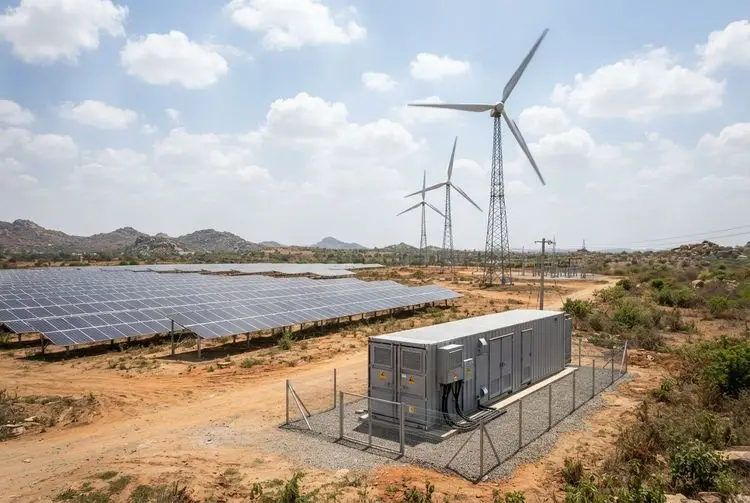
Battery storage is emerging as a decisive factor in solar economics across vastly different markets this week. In India, a major investment agreement hinges on policy clarity for storage, while in the Netherlands, a consumer-driven battery boom is reshaping how households use rooftop solar.
Fourth Partner Energy Signs ₹2,000 Crore MoU in Andhra Pradesh
Renewable energy developer Fourth Partner Energy (FPEL) has signed a memorandum of understanding with the Andhra Pradesh government to invest approximately ₹2,000 crore in three renewable energy projects. The company plans to develop two solar power projects with capacities of 120 MWp and 117 MWp, along with a hybrid project comprising 60 MW of wind and 60 MWp of solar capacity.
The proposed investment expands FPEL's existing renewable energy portfolio in Andhra Pradesh, where the company already operates solar projects serving commercial and industrial (C&I) customers. FPEL has not specified the locations or commissioning timelines for the three proposed projects.
Speaking at a summit, FPEL highlighted the need for regulatory clarity on battery energy storage systems (BESS) and the release of government orders associated with older wind energy projects. The company's call for policy certainty reflects a broader industry concern: while renewable generation capacity is expanding rapidly, the enabling framework for storage — critical to integrating variable solar and wind — remains a work in progress in many Indian states.
Chief Minister Chandrababu Naidu, at the same summit, identified critical minerals, solar wafer manufacturing, solar power generation, and battery storage among the state's priority sectors. Other areas highlighted included steel, defence, space, semiconductor manufacturing, and data centres. The inclusion of battery storage signals political recognition of its strategic importance to Andhra Pradesh's industrial ambitions.
FPEL said it aims to expand its renewable energy portfolio to 9 GW by 2031 through faster project execution and expansion of its C&I customer base. As of September 2026, the company had 2 GW of installed solar and wind capacity, with another 3 GW of projects under active development across India.
Netherlands: Home Battery Installations More Than Double
In a separate but thematically linked development, residential battery uptake in the Netherlands more than doubled over nine months, according to data from Sunergy Research, a company that sells services to Dutch households with solar panels. The surge comes as the Netherlands prepares to end its residential solar net metering scheme on January 1, 2027.
Dutch households currently use only about 30% of their rooftop solar power themselves, sending the rest to the grid. A home battery could raise self-consumption to roughly 70%, according to Rolf Heynen, chief executive of Sunergy Research. Heynen credits the net metering incentive — which is approaching its phaseout — with helping make rooftop solar financially appealing in the first place. Under net metering, a steady rate of €0.21 per kilowatt-hour made solar economics simple to calculate. However, rising electricity prices and dynamic tariffs have complicated that math for homeowners.
Sunergy's figures show that installations of 5- to 15-kilowatt-hour batteries nearly tripled between January and September. Growth was even stronger for smaller systems — those storing no more than 5 kilowatt-hours — which roughly quadrupled in the same period. Heynen said the bigger, permanently installed systems tend to appeal to households that have already gone deep into electrifying their homes, while the smaller batteries are pulling everyday households into the market for the first time.
He also pointed to a coming shift to variable grid pricing, set to start in 2029, as another factor shaping household energy decisions beyond the end of net metering.
Plug-in batteries lead the Dutch home battery market despite being a comparatively new option, according to Sunergy's data. Installations more than doubled during the nine-month period covered. For households interested in backup without a whole-home installation, Pila offers a plug-and-play battery alternative at a substantially lower price point than whole-home backup systems.
Batteries configured for backup can keep selected essentials powered during outages, while systems designed for off-grid use can supply electricity away from a utility connection. Storage paired with solar can also trim monthly electricity costs, since power that would otherwise sell back to the grid at a reduced rate can instead cover a household's own use.
Common Challenge, Different Stages
Both developments converge on a central theme: battery storage is becoming indispensable to the economics of solar power, whether at utility scale or on residential rooftops. In India, FPEL's call for BESS regulatory clarity reflects the need for policy frameworks that allow storage to be deployed at scale alongside large renewable projects. In the Netherlands, the phaseout of net metering is forcing homeowners to reconsider the value of exporting surplus solar and to invest in batteries to maximize self-consumption.
The two markets are at different stages of maturity. India's utility-scale and C&I solar sector is still expanding rapidly, with FPEL targeting 9 GW by 2031 and 3 GW already under active development. The Netherlands, by contrast, has a mature residential solar market where the policy focus is shifting from installation incentives to managing grid interactions and self-consumption. Yet both face a common challenge: aligning regulatory and pricing frameworks with the technical realities of storage.
One notable difference is the role of government. In Andhra Pradesh, the Chief Minister's identification of battery storage as a priority sector suggests top-down support, even as FPEL seeks specific policy clarifications. In the Netherlands, the shift is more market-driven, with homeowners responding to the impending end of net metering and the prospect of variable grid pricing in 2029. The Dutch example also highlights the emergence of plug-in batteries as a lower-cost entry point for everyday households, a segment that has historically been slower to adopt storage.
Broader European Trends
The Dutch experience is not isolated. Similar trends are emerging across Europe, including the U.K. and Poland, where falling export payments make home batteries more attractive. Examples cited include a Dutch solar owner rejecting pricey compatible batteries as 2027 export charges loom; U.K. solar owners saying falling export payments make home batteries increasingly crucial; Poland allowing larger home batteries if electricity exports remain capped; a U.K. homeowner weighing a £2,330 battery addition against an estimated 13-year payback; and a U.K. solar owner weighing a £2,500 home battery against 90p in peak-rate electricity.
These examples illustrate a common calculus: as export rates decline and peak electricity prices rise, the payback period for home batteries shortens, making storage a rational investment for many households.
Outlook for Industry Professionals
For solar industry professionals, installers, investors, and engaged homeowners, the message is clear: battery storage is no longer a niche add-on but a core component of solar economics. In India, the pace of utility-scale and C&I storage deployment will depend on regulatory clarity and government orders, as FPEL's comments suggest. In the Netherlands and across Europe, the residential battery market is already accelerating, driven by policy changes and evolving electricity pricing. Both markets underscore the importance of storage in maximizing the value of solar generation — whether by enabling self-consumption at home or by supporting grid integration at scale.