
Co-RoboPV: DRL-powered multi-robot system boosts PV inspection
New cooperative aerial robot system uses deep reinforcement learning for autonomous solar farm inspection.
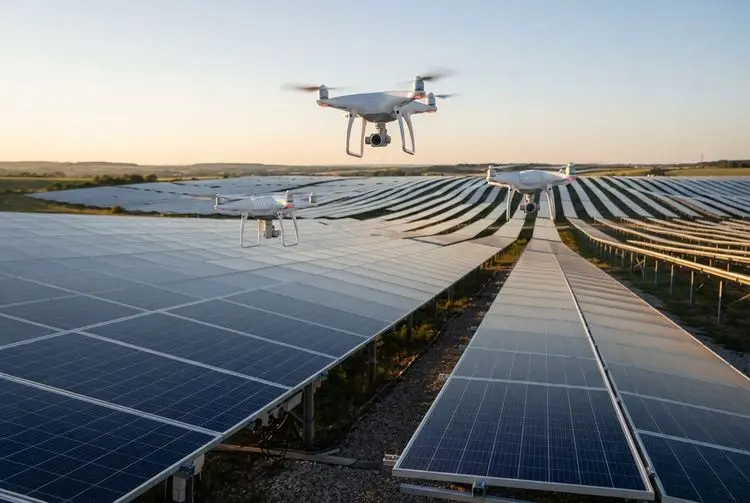
Researchers have developed Co-RoboPV, a cooperative multi-aerial robot system for photovoltaic (PV) inspection that uses Deep Reinforcement Learning (DRL) for online path planning. The system achieves approximately 99.5% coverage with a revisit rate of around 12.6%, according to test results.
The framework addresses a key limitation in existing PV inspection methods, which typically rely on pre-computed offline paths or require heavy onboard computation. Co-RoboPV enables multiple aerial robots to plan their inspection routes in real time, adapting to the layout of solar arrays without prior knowledge of the environment.
How the system works
Co-RoboPV divides the inspection area using Voronoi-based subarea decomposition, assigning each aerial robot a distinct region based on its position. This approach allows the system to scale to larger environments and more robots without requiring centralised coordination.
Each agent uses a modified Deep Q-Network (DQN) architecture that combines several enhancements: Prioritized Experience Replay (PER), Dueling DQN, Double Q-learning, and NoisyNet. The Dueling DQN splits the Q-value into separate state-value and advantage streams, while Double Q-learning reduces overestimation by decomposing the max operation. PER prioritises experiences by their temporal-difference (TD) error for more efficient learning, and NoisyNet learns weight perturbations for consistent exploration.
The neural network uses four convolutional layers with 3×3 kernels and batch normalisation, producing a feature map size of 8,192. Training was conducted over 15×10³ episodes on randomly generated 16×16 grid environments, taking approximately 27 hours. The replay buffer stores 100,000 experiences, with a batch size of 256 and a learning rate of 0.00015. The discount factor (γ) is set at 0.99, and exploration decays from 1 to 0.1 at a rate of 0.0003 per episode. The target network uses a soft update parameter (τ) of 5e-4, with a prioritisation exponent (α) of 0.5 and a TD error offset (ε) of 0.5.
Performance results
Over five runs, Co-RoboPV achieved a mean coverage of 99.49% ± 0.47% and a revisit rate of 12.6% ± 0.78%. The mean total reward over the last 1,000 episodes reached 210.27 ± 3.185. During inference, each action step takes approximately 0.03 seconds, enabling real-time decision-making.
Collision avoidance between agents is handled through a repulsive force mechanism. The system uses a double integrator model for agent motion simulation, with PID control input guiding movement to goal positions.
Simulation and scalability
The researchers used the Digital-PV platform, built on Unreal Engine and AirSim, for simulation testing. The framework supports arbitrary area shapes and online path planning, making it adaptable to real-world solar farm layouts.
While training was conducted on 16×16 grid environments, the system demonstrated scalability in a 32×32 environment with nine aerial robots. The Voronoi decomposition method allows the framework to handle larger areas and additional robots without fundamental architectural changes.
Context for the solar industry
Co-RoboPV builds on earlier work by Moradi et al., who developed RoboPV, a single-robot autonomous aerial monitoring framework for PV inspection. The shift from single to multi-robot systems addresses a practical bottleneck: inspecting large utility-scale solar farms with one drone is time-consuming and limits the frequency of inspections.
Existing coverage path planning (CPP) methods fall into model-based and non-model-based categories. Model-based approaches include geometry-based, grid-based, and exact cell decomposition methods. While effective in structured environments, these methods often struggle with irregular site layouts or require significant pre-computation.
The DRL-based approach in Co-RoboPV offers an alternative. Because the system learns online and adapts to the environment during flight, it can handle irregular array shapes, partial shading, and dynamic obstacles without requiring a pre-computed flight plan. For solar asset owners and O&M providers, this could mean faster, more frequent inspections with less downtime.
The system's ability to scale to nine or more aerial robots is particularly relevant for large solar farms spanning hundreds of hectares. Rather than deploying a single drone on a slow, methodical sweep, operators could launch a coordinated fleet that covers the site in a fraction of the time.
Technical stack and integration
The simulation environment uses Pixhawk autopilot hardware, Raspberry Pi onboard computers, the PX4 flight stack, and QGroundControl ground station software. Communication between agents relies on the MAVlink protocol and MicroDDS middleware, which are standard in commercial drone operations.
For solar industry professionals evaluating drone-based inspection solutions, the use of widely adopted open-source flight software and protocols suggests that Co-RoboPV could be integrated with existing drone fleets without requiring proprietary hardware.
The researchers trained the system on randomly generated grid environments rather than on specific solar farm layouts. This approach is intended to improve generalisation, meaning the system should perform across different site geometries without retraining for each location.
What to watch
While the results are promising, the system has so far been demonstrated only in simulation. Real-world deployment would need to address factors such as variable lighting conditions, GPS accuracy, wind, and the thermal signatures of operating PV modules, which can affect both navigation and inspection quality.
The revisit rate of 12.6% indicates that the system occasionally re-inspects areas already covered. For O&M applications, some overlap may be acceptable or even desirable for critical defect detection, but reducing unnecessary revisits would improve overall inspection efficiency.
The 0.03-second inference time per action step suggests the system can run on modest onboard hardware, which is important for real-time operation without relying on a ground-based processing unit.
Co-RoboPV represents a step toward fully autonomous, multi-robot PV inspection that does not require pre-mapped flight paths. As solar farms continue to grow in size and number, such systems could become a standard tool for asset monitoring and maintenance planning.