
Korean field test reveals real-world performance of modular PVT system
Two-week trial in Dangjin-si shows electrical and thermal efficiency data from a modular liquid PVT setup.
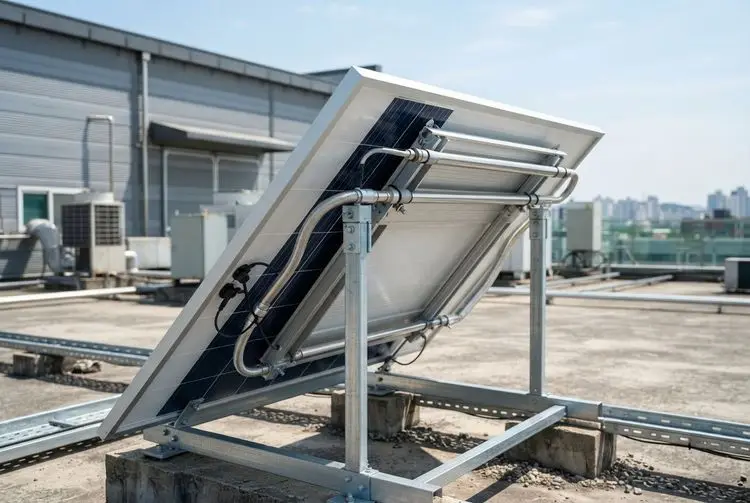
Researchers in South Korea have published field test results for a modular liquid photovoltaic-thermal (PVT) system, offering rare real-world performance data for a technology that has mostly been studied in laboratories or through simulations.
The field trial took place at Janghan Technology Co. in Dangjin-si, Chungcheongnam-do, and collected data at 15-minute intervals over two weeks from June 15 to June 28, 2025. The research team — Minseo Park, Hooseung Na, Sungwoong Yang, and Su-Gwang Jeong — presented their findings in the Architectural Research journal.
Standard silicon solar cells convert only about 15% to 20% of incoming solar radiation into electricity. The remainder heats the module, which reduces electrical efficiency. PVT systems address this by recovering that waste heat for useful thermal applications, such as water heating or building heating.
Modular design tested under real conditions
The test system used a modular liquid heat exchanger attached to the rear of a standard 275 W PV module measuring 1,675 x 1,001 x 115 mm. The module was mounted at a tilt angle of 31.3 degrees, facing due south. Unlike many previous laboratory studies, the heat exchanger was attached without thermal bonding adhesive between it and the PV backsheet.
The system operated as a closed loop, circulating a mixture of water and propylene glycol at 40% propylene glycol by weight. The fluid had a density of 1.063 kg/L at 10°C and a specific heat of 0.89 kcal/kg/°C (3.72 kJ/kg·K). The average flow rate was 0.96 L/min, with a range of 0.83 to 1.03 L/min. Data points recorded at flow rates below 0.5 L/min were excluded from the analysis.
Electrical and thermal efficiency results
Over the test period, the system's electrical efficiency ranged from 5.18% to 5.89%, with a mean value of 5.44%. This is lower than the typical conversion efficiency range for standard silicon cells, reflecting the fact that the module used was a commercial unit and that the PVT configuration introduces some thermal coupling effects.
Thermal efficiency showed a much wider spread, ranging from -5.30% to +13.38%, with a mean of 4.06%. The negative thermal efficiency values occurred when the storage tank temperature was already high, meaning the fluid could not effectively extract heat from the module and instead lost heat to the environment. The peak thermal efficiency was recorded during morning hours, when the storage tank was coolest and the temperature differential was greatest.
For context, previous laboratory studies of PVT systems have frequently reported thermal efficiencies exceeding 40%. The significantly lower figure in this field test highlights the gap between controlled lab conditions and real-world operation, where factors such as ambient temperature, wind, and storage tank thermal state play a major role.
Key correlations and system behavior
Regression analysis showed a strong linear relationship between electrical output and irradiance, with the equation P = 2.289 + 0.833 × irradiance and an R² value of 0.944. This confirms that electrical generation in the PVT system is primarily governed by available sunlight, as expected.
Thermal performance, by contrast, was governed by the thermal state of the storage tank. When the tank was cool, the system could extract significant heat from the module. When the tank was already warm, heat extraction dropped and could even reverse, producing the negative efficiency values observed.
This finding carries practical implications for system designers and installers. A PVT system without adequate thermal storage or a means of rejecting heat when the tank is saturated will see diminishing thermal returns during sustained high-irradiance periods. Proper sizing of the storage tank and consideration of the building's thermal load profile are essential for maximizing overall system performance.
What the results mean for the industry
The modular approach tested here is notable because it allows the same heat exchanger design to be used with different commercial PV panels, potentially lowering manufacturing complexity and cost. The absence of thermal bonding adhesive also simplifies assembly, though it may reduce thermal transfer efficiency compared to bonded designs.
For solar professionals evaluating PVT technology, the field data from this Korean trial provides a realistic benchmark. The mean electrical efficiency of 5.44% and mean thermal efficiency of 4.06% represent combined energy yields that are modest compared to standalone PV or solar thermal systems, but the value proposition of PVT lies in delivering both electricity and heat from a single footprint — particularly relevant for buildings with limited roof space.
The building sector accounts for a large share of global energy use and emissions, and PVT systems offer a pathway to on-site generation of both electricity and thermal energy. However, the results underscore that real-world performance depends heavily on system design, storage sizing, and operating conditions. Field validation of the kind conducted in Dangjin-si will be critical as the technology moves toward broader commercial deployment.