
Duke Energy Florida Files for 300 MW Solar Portfolio, Projects $1B in Customer Savings
Four new solar sites in Orange and Sumter counties target mid-2028 completion with Inflation Reduction Act benefits.
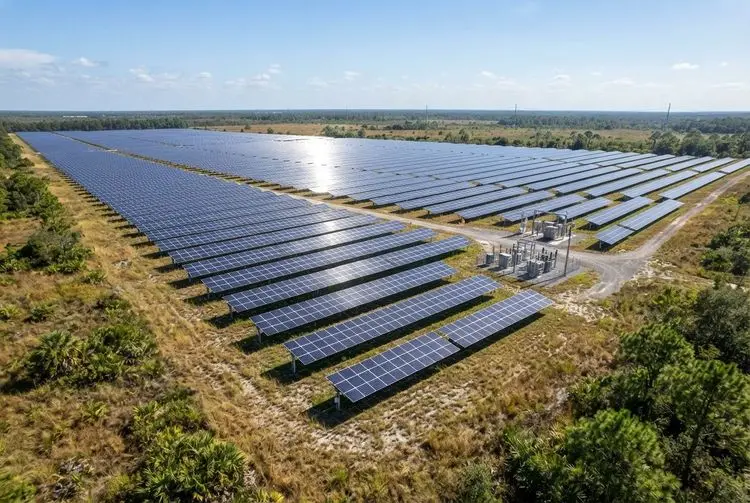
Duke Energy Florida has submitted regulatory applications to the Florida Public Service Commission for four new solar photovoltaic facilities totaling 300 MW across Orange and Sumter counties. The utility projects the portfolio will deliver approximately $1 billion in customer savings over a 30-year operational life. The November 2026 filings mark a significant expansion in a state that now ranks third nationally for installed solar capacity.
Project Timeline and Portfolio
The four solar energy centers follow staggered construction schedules. The Nova Renewable Energy Center in Orange County is slated to begin construction in January 2027 with completion expected in February 2028. The Bull Creek Renewable Energy Center, also in Orange County, will start construction in March 2027 and reach completion in April 2028.
In Sumter County, the Hogeye Renewable Energy Center is scheduled to break ground in May 2027 with completion targeted for May 2028. The Wewahootee Renewable Energy Center in Orange County will begin construction in May 2027 and is expected to be completed in June 2028.
Customer Savings and Fuel Displacement
Duke Energy estimates each individual solar site will save customers approximately $250 million in fuel costs over its operating life by reducing reliance on natural gas, oil, and coal. The utility calculates that the zero-emission electricity generated at each site displaces approximately 1.1 million cubic feet of natural gas, 12,000 barrels of fuel oil, and 9,000 tons of coal annually.
Duke Energy Florida is leveraging provisions of the Inflation Reduction Act to transfer an estimated $75 million in production tax credits to customers per year. The company says this reduces monthly bills by at least $2.50 per 1,000 kilowatt-hours of electricity used. Additionally, the utility is accelerating the delivery of federal investment tax credits tied to the Powerline Battery Energy Storage System in Citrus County. This tax credit acceleration is designed to offset a scheduled base rate increase and help lower customer bills in 2027.
Florida's Solar Market Context
The expansion aligns with Florida's broader clean energy momentum. According to the Solar Energy Industries Association (SEIA), Florida ranks third in the United States for total installed solar capacity, boasting 22.5 GW of operational solar that powers over 2.7 million homes. The state's solar market accounts for $33.7 billion in capital investment and supports 14,303 solar jobs across 473 local companies, with an additional 12,850 MW projected over the next five years.
Other industry data cited in coverage of the announcement notes that Florida produces 30,131 GWh of solar power, powering more than 2.4 million homes through over 286,000 installations. Florida is described as the third-fastest-growing state in the nation, driving rising electricity demand that these new projects aim to help meet.
Duke Energy's Existing Florida Footprint
Duke Energy Florida currently owns, operates, and maintains 25 solar energy sites totaling 1,850 MW. Each site can power approximately 15,000 homes, according to the company. Duke Energy is a Fortune 150 company headquartered in Charlotte, North Carolina, and one of America's largest energy holding companies. Its electric utilities serve 8.7 million customers across North Carolina, South Carolina, Florida, Indiana, Ohio, and Kentucky. The company owns 55,700 megawatts of energy capacity and is pursuing an energy modernization strategy prioritizing customer value and grid upgrades.
Industry Perspectives
Coverage of the announcement has generally emphasized the positive economic and environmental implications of the expansion. One industry report framed Duke Energy as a leading force in the clean energy transition, highlighting the productive partnership between private companies and states like Florida in executing beneficial projects rapidly. That report also suggested Duke Energy is positioned among the companies that will lead the next generation of the solar sector.
A separate industry publication focused on the utility- and industry-friendly aspects of the filing, framing the solar expansion as a win for customers through cost savings and rate mitigation while highlighting Florida's broader clean energy momentum and economic benefits such as capital investment and job creation.
If approved by the Florida Public Service Commission, the projects would begin construction in early 2027 and be fully operational by mid-2028, contributing to a state solar market that continues to rank among the nation's largest and fastest-growing.