
SPONSORED

ENGIE Adds 450 MW Solar in India as Brazil Auction Reshapes Grid

French energy group commissions two Indian solar projects while competing in Brazil's transmission tender.
•• 6 Min
ENGIE Adds 450 MW Solar in India as Brazil Auction Reshapes Grid

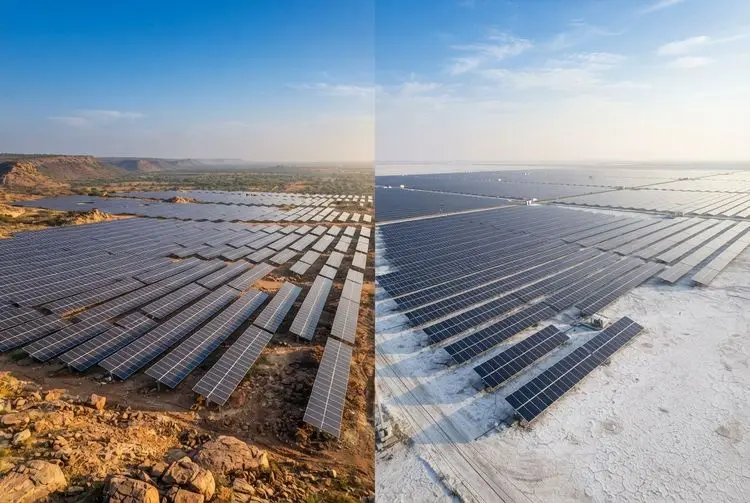
ENGIE has started commercial operations for 450 MW of new solar capacity across two Indian states, while simultaneously participating in a major Brazilian transmission auction that delivered steep consumer savings — a dual move that underscores the company's strategy of expanding renewable generation while competing for grid infrastructure.

The 250-MW Khaba solar project in Barmer, Rajasthan, was developed through Khaba Renewable Energy Pvt Ltd, a wholly-owned ENGIE subsidiary. The 200-MW Khavda project, located in Gujarat's Khavda Renewable Energy Park in the Rann of Kutch, was developed through Enren II Energy Pvt Ltd. Together, the two projects add significant scale to ENGIE's Indian portfolio.

Approximately 80 percent of the construction workforce for both projects was hired locally, according to the company. The Khaba facility is expected to generate roughly 650 GWh of electricity annually and avoid nearly 180 kilotonnes of carbon dioxide emissions each year. The Khavda project, operating under a 25-year Power Purchase Agreement (PPA) with Gujarat Urja Vikas Nigam Ltd, will generate approximately 350 GWh annually.

Amit Jain, CEO & Country Manager India and Managing Director Renewables & Batteries SEA at ENGIE, called the commissioning "an important milestone for ENGIE in India, adding 450 MW of new renewable capacity to our operational portfolio." Pedro Vasconcelos, ENGIE Executive Vice President in charge of Renewable & Flexible Power, added that "India is a key growth market for ENGIE, where we are continuing to build scale and momentum as we contribute to one of the world's major energy transitions."

Battery storage expansion underway

The solar additions come amid broader momentum for ENGIE in India. The company secured its first battery storage projects in the country late last year: a 280 MW/560 MWh battery energy storage system (BESS) in November 2025, followed by a hybrid project in January 2026 combining 200 MW of solar with a 100 MW/600 MWh battery storage system. With roughly 2 GW in operation or under construction across India, ENGIE is integrating renewable generation with flexibility solutions to serve growing demand for reliable, low-carbon electricity.

Brazil transmission auction delivers 50% discount

In a separate development, Brazil's Transmission Auction No. 4/2026 concluded at B3 in São Paulo with all eight lots awarded and an overall discount of 50.10 percent. The auction reduced annual revenue from approximately R$ 1.63 billion to R$ 811.1 million — an annual reduction of R$ 814.32 million compared to the ceiling set by ANEEL, the National Electric Energy Agency. Over the 30-year concession period, estimated savings reach R$ 24.43 billion, excluding adjustments or monetary updates.

Planned investments total R$ 8.9 billion, covering 1,866 kilometers of new transmission lines, continued operation and maintenance of 483 kilometers of existing lines, and transformation facilities totaling 12,694 MVA. The projects span seven states: Bahia, Goiás, Mato Grosso do Sul, Paraíba, Paraná, Rondônia, and São Paulo. ANEEL expects roughly 20,000 jobs to be generated across the production chain during construction. Implementation timelines range from 42 to 60 months after contracts are signed, scheduled for February 2027, with commercial operation expected between August 2030 and February 2032.

Talita Porto, CEO of ABRATE (Brazilian Association of Electricity Transmission Companies), said the auction result proves that competitiveness brings significant benefits to consumers. "It's about continuously modernizing the system. The incorporation of assets such as synchronous compensators provides the inertia and stability that the Interconnected System needs to integrate the advancement of renewable sources and prepare the country for the electrification of industry and mobility," she observed.

Lot winners and key projects

Celeo Redes won Lot 4, the largest in the auction, with an Annual Permitted Revenue (RAP) of R$ 377.09 million and a discount of 50.55 percent. The bid surpassed offers from competitors including Axia Energia and ENGIE. The package includes investments estimated at R$ 4.11 billion — nearly half of the total projected for the auction — and comprises 1,167 kilometers of lines and 3,600 MVA of transformation capacity across Mato Grosso do Sul, Paraná, Goiás, and São Paulo. Celeo also won Lot 8 in Rondônia with a bid of R$ 66.66 million and a discount of 48.02 percent. Together, the two lots represent approximately R$ 4.87 billion in investments.

Neoenergia Transmissão won Lots 1 and 7. Lot 1 was secured in a close open outcry bidding stage against Tradetek Soluções em Iluminação Pública e Infraestrutura, with an offer of R$ 59.85 million representing a 51.21 percent discount. Lot 7 was won with a bid of R$ 68 million and a 38.55 percent discount.

Cymi Construções e Participações also won two lots. In Lot 3, it presented a RAP of R$ 78.70 million and achieved the largest discount in the auction at 57.08 percent. Lot 5 was won with an offer of R$ 96.40 million, equivalent to a 46.36 percent reduction from the ceiling.

Cox Brasil won Lot 6 for R$ 37.85 million with a 53.46 percent discount, and EDP Transmissão Goiás won Lot 2 with a bid of R$ 26.53 million and a 53.29 percent discount.

Grid upgrades to support renewable integration

Several lots are specifically designed to support the integration of renewable energy sources. Lot 7 focuses on the Sertão region of Paraíba, including the Coremas II substation (500/230 kV) and the Cajazeiras II substation (230/69 kV), comprising 113 kilometers of lines and 2,100 MVA of transformation capacity with a 42-month implementation timeframe. Lot 8 involves installing three synchronous compensators at the Porto Velho Collector substation in Rondônia, each with an operating range of -200 to +300 MVAr, to support voltage and increase transmission system resilience amid climate change effects.

Lot 4's complex includes the 500 kV Rio Brilhante–Sarandi double-circuit lines, the Rio Verde Norte–Chapadão and Chapadão–Rio Brilhante lines, expansions at the Rio Brilhante and Chapadão substations, and synchronous compensation at Rio Brilhante. With a 60-month implementation period, the works will reinforce electricity supply to Mato Grosso do Sul and expand generation connection capacity.

Other lots address regional demand growth. Lot 1 includes 238 kilometers of new 230 kV lines in Bahia and continued operation of 483 kilometers of existing lines. Lot 2 covers Goiás and Bahia with 126 kilometers of circuits. Lot 3 centers on the Santana substation in Mogi das Cruzes, São Paulo, with 500/345 kV and 3,600 MVA capacity. Lot 5 serves the Curitiba Metropolitan Region with 173 kilometers of lines and 2,094 MVA of transformation capacity. Lot 6 includes the Iguaçu substation in Paraná with 900 MVA transformation capacity.

While ENGIE competed for but did not win the largest transmission lot in Brazil, the company's simultaneous commissioning of 450 MW of solar in India reflects its dual-track approach: building generation assets in high-growth markets while pursuing grid infrastructure opportunities that enable further renewable deployment.

ENGIESolar IndiaBrazil Transmission AuctionKhaba SolarKhavda SolarANEELBattery StorageRenewable Energy

Most Popular News

  1. Greenhushing rises as solar costs fall and grid access becomes king
  2. MIT study: Excess renewable energy could power factories and data centers
  3. IHCL switches on 500-kW solar plant at Taj Fort Aguada in Goa
  4. Adaptive water cooling stabilizes hybrid solar collector across three climates
  5. Section 232 solar tariffs take effect Dec 4, reshaping US supply chain

Disclaimer


Important notice regarding existing conflicts of interest:

We expressly point out that conflicts of interest exist in connection with this publication:

1. Stock Market Media Ltd. and persons closely associated with it hold shares in the companies recommended here and intend to sell them within the scope of, and at any time during, this recommendation. This constitutes a clear and specific conflict of interest.

2. The publisher of this publication and the responsible editors receive financial remuneration for its preparation. This, too, constitutes a clear and specific conflict of interest.

3. Please also note the further statements on existing conflicts of interest in the disclaimer below, inter alia under no. 2.

Important information and mandatory disclosures pursuant to the German Securities Trading Act (Wertpapierhandelsgesetz, WpHG) and pursuant to the German Financial Investment Ordinance (Finanzanlageverordnung, FinAnV).

Stock Market Media Ltd. has notified the German Federal Financial Supervisory Authority (Bundesanstalt für Finanzdienstleistungsaufsicht, “BaFin”), pursuant to the WpHG, of its activity as a producer of investment strategy recommendations within the meaning of Article 3(1) point 34 of Regulation (EU) No 596/2014 or of investment recommendations within the meaning of Article 3(1) point 35 of Regulation (EU) No 596/2014 (formerly “financial analyses”). The obligations of Stock Market Media Ltd. are governed primarily by §§ 85, 86 WpHG, Regulation (EU) No 596/2014 and Delegated Regulation (EU) 2016/958.

Information on the producer(s) of this publication:
Mr Roberto Gonçalves de Albuquerque, as analyst and editor-in-chief, is responsible for the preparation of the texts and contents of this publication. The publisher is Stock Market Media Ltd., 405 Kings Road, Flat 600, London; SW10 0BB, United Kingdom, represented by its Director Roberto Gonçalves de Albuquerque.

Important notes on the preparation of this publication:
This publication contains both facts and factual information on the companies discussed and purely subjective value judgements, interpretations, estimates, projections, forecasts and price targets. We endeavour to distinguish these from one another as transparently as possible in order to avoid misleading statements. Research, preparation and wording are carried out using common digital and AI-supported tools; the review of the content and the editorial responsibility lie with us. The essential bases and standards of our value judgements and valuations of the shares discussed are based on the following approach:

Assessment and valuation of companies according to conventional valuation methods (fundamental valuation approach)

  • Assessment of the potential of the company's future development (growth approach) and projection onto the corresponding valuation potential (price potential analysis) as well as a possible valuation of the company's shares on the basis of potential profit expectations (P/E ratio projection)
  • Assessment of the best-case scenario expected by us in the event of the company's absolute success (blue-sky potential approach)
  • Effect on the share price of the increased awareness of the recommended share expected by us, resulting from a strong rise in demand on the market (particularly decisive in the case of illiquid shares or shares recommended newly or for the first time) on account of the publications (mostly buy recommendations) published by us or by third parties (multiplier / momentum effect, hype), and thereby a disproportionately rising return/share price with a correspondingly rising risk
  • Technical analysis of the share price in accordance with common methods of analysis, mostly for the prediction of price signals (buy or sell signal, breakout of the share, determination of price targets, support or resistance areas, expected minimum movements or minimum counter-movements, prediction of signal points (if-then), etc.), for the most part building on the expected mass psychology (technical approach).

Conventional valuation approaches often cannot be meaningfully applied to young companies or companies that do not yet generate revenue. In valuing such companies we therefore tend to rely on the potential analysis calculated by us and on the assessment of the demand for such shares on the capital market. Ultimately, the market decides on the share price of a company. If extensive recommendations of a share give rise to excessive demand for it, it is possible that the share price will rise at an above-average rate on high trading volume. Although this leads to extreme opportunities for profit, it correspondingly increases the risk of a bubble forming, with a corresponding fall in price. The increased volatility of the share in such situations gives rise to above-average opportunities for profit and loss, both in both trading directions and in the case of recurring counter-movements. Such market developments are also an important part of our trading recommendations and valuation approaches.

This publication deals exclusively with securities of above-average volatility with high potential for profit and also for loss.

Note on sources of information:
The reliability of sources of information is examined by us in detail before they are used and is subjectively assessed by us according to their credibility and significance. In doing so, we decide by our own standards which sources we consider relevant, too conservative or too optimistic. Ultimately, we determine our recommendations on the basis of our personal assessments. In obtaining information we draw on numerous publicly accessible sources such as press releases, ad hoc announcements, company announcements, company presentations, publications and articles on the company discussed, common financial media in Germany and abroad as well as company or sector analyses by third parties.

Our publications use exclusively publicly available information and sources as well as information disseminated by the company itself.

Note on existing conflicts of interest:
We hereby point out that shareholders, editors, employees and persons or companies involved in the preparation of this publication, as well as principals (third parties) commissioning the publication of Stock Market Media Ltd., hold, directly or indirectly, at the time of this publication, interests in securities which are discussed in the respective publication, and are therefore interested in an increase in price and/or turnover, i.e. also in increased trading liquidity, since it is intended to sell these securities in direct connection with this publication and to participate in rising prices and turnover. An increase in the price of the shares of the companies presented may lead to an increase in the assets of these persons. In any case, the share price of the company may be significantly influenced by the discussion of the company. In particular, the share price of the companies discussed is also materially influenced by securities transactions. This applies in particular where the companies concerned are ones whose shares do not have a broad market capitalisation and for which only a narrow market exists. Here, even small order volumes can have considerable effects on prices. However, they are also interested in the price of the company discussed falling if they wish to acquire its shares more cheaply. By law, this gives rise to a conflict of interest, to which we hereby expressly draw attention.

Stock Market Media Ltd. and its employees are furthermore remunerated for the preparation, electronic distribution and publication of this publication as well as for other services. By law, this gives rise to a conflict of interest, to which we hereby expressly draw attention.

This remuneration may be paid by the company about which Stock Market Media Ltd. publishes information, by third parties affiliated with these companies or by other third parties pursuing an interest with regard to the companies discussed in connection with this publication. By law, this gives rise to a conflict of interest, to which we hereby expressly draw attention. This arises, first of all, from the fact that Stock Market Media Ltd. could make its statements in the interest of its principal. Stock Market Media Ltd. and/or companies affiliated with it have entered into an agreement, for a fee, with the company in question or with its shareholders for the preparation of the editorial coverage. By law, this gives rise to a conflict of interest, to which we hereby expressly draw attention.

Note on the handling of internal organisational duties:
Owing to the small size of the publisher's business, internal control of the compliance processes of the employees and other parties contributing to this publication is limited.

Competent supervisory authority:
Stock Market Media Ltd. has notified BaFin of its activity pursuant to § 86 WpHG.