
Good Energy urges UK business rates relief extension for solar
Good Energy calls on government to extend Improvement Relief to remove a key barrier to commercial solar deployment.
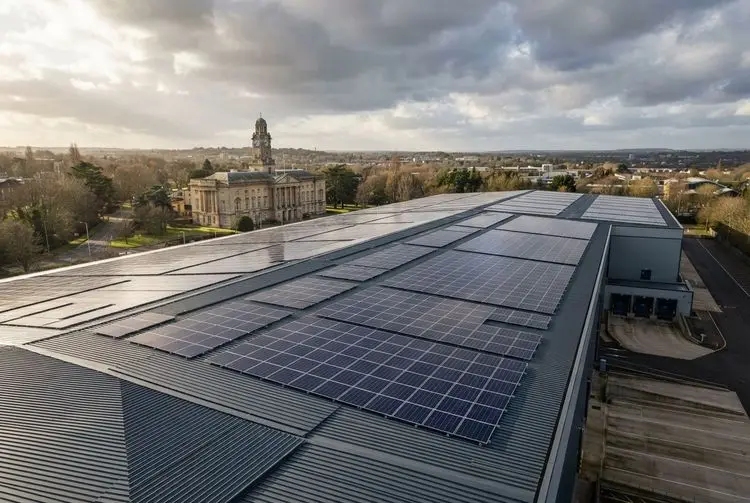
Good Energy has urged the UK government to extend the Improvement Relief scheme, warning that business rates remain a practical barrier to commercial and industrial solar deployment.
The Improvement Relief scheme delays any increase in business rates caused by property improvements — including the installation of solar panels — by one year. The scheme is currently set to end in 2029, subject to government review. Where the criteria are met, the relief is mandatory for local authorities to grant.
The call comes as solar installers and property owners navigate a complex landscape where adding rooftop generation can raise a building's rateable value, increasing the tax burden on landlords or tenants depending on their lease agreement.
The rates problem for solar
Business rates in England are calculated based on a property's rateable value. Installing solar panels increases that value, which in turn raises the rates payable. Improvement Relief delays that increase by 12 months, giving businesses a window to benefit from lower energy costs before the higher rates take effect.
Carl Hogg, managing director of services at Good Energy, said the financial case for on-site solar is strong for the right businesses.
"The opportunity is particularly compelling for businesses consuming large amounts of electricity during the day, because power generated on the roof can be used directly on site," Hogg said.
However, he added that practical barriers still hold projects back.
"What we need to focus on now are the practical barriers stopping projects from getting off the ground, whether that is the relationship between landlord and tenant, the condition of the roof, finance or difficulties around connecting to the grid," Hogg said.
Lease complexities and payback mismatches
The relationship between landlord and tenant is a recurring obstacle. Lease lengths often do not match the payback period for a solar investment, creating a split incentive. A tenant may not want to fund a system whose benefits extend beyond their lease term, while a landlord may see little reason to invest in generation that primarily cuts a tenant's electricity bill.
Further legal complexity arises from how solar assets are classified. Under UK law, solar panels may be treated as "plant and machinery" rather than a property asset, which affects depreciation, tax treatment and ownership rights. The Corporation Tax Act 2010 may not cover income from solar generation in some leasing structures, adding uncertainty for non-specialist parties entering power purchase agreements (PPAs).
Rebecca Cullen of Browne Jacobson highlighted the need for clear contractual terms.
"The parties will be largely non-specialist counter-parties in these arrangements, and the terms around tariff review mechanisms, step-in rights, roof condition warranties, and exit provisions will all need to be fair and clearly understood by those signing them," Cullen said.
Real-world deployment: BSH Corby
A working example of commercial rooftop solar is the BSH distribution warehouse in Corby. The site's solar installation generates approximately 550 MWh annually, covering around 75% of the warehouse's on-site power consumption. The system cuts utility costs immediately, illustrating the direct benefit of on-site generation for day-time power users.
Yet even successful projects face the rates question. As the Improvement Relief scheme approaches its 2029 end date, businesses considering solar investments face uncertainty over whether the one-year rate delay will still be available when their projects come online.
Alternative approaches and policy context
For businesses that cannot or do not want to own solar assets directly, a PPA with a third-party provider offers an alternative. Under this model, a developer installs and owns the system, selling the power to the site occupant at a agreed rate. This avoids the upfront capital cost and shifts ownership-related liabilities — including business rates — to the provider.
The UK government has piloted a PPA scheme for schools, signalling awareness of the model's potential in the public sector. However, for commercial landlords and tenants, insurance liabilities on solar arrays also need to be agreed in advance, adding another layer to negotiations.
Good Energy's call to extend Improvement Relief is part of a broader push to remove non-technical barriers to solar deployment. With the scheme's future under review, the industry is watching for clarity on whether the relief will be extended beyond 2029 — and whether the government will address the wider structural issues around business rates and renewable energy investment.