
Rajasthan mandates agri land conversion for all renewable energy projects
New rules reverse a 2014 provision, requiring mandatory land-use conversion for solar, wind and storage projects.
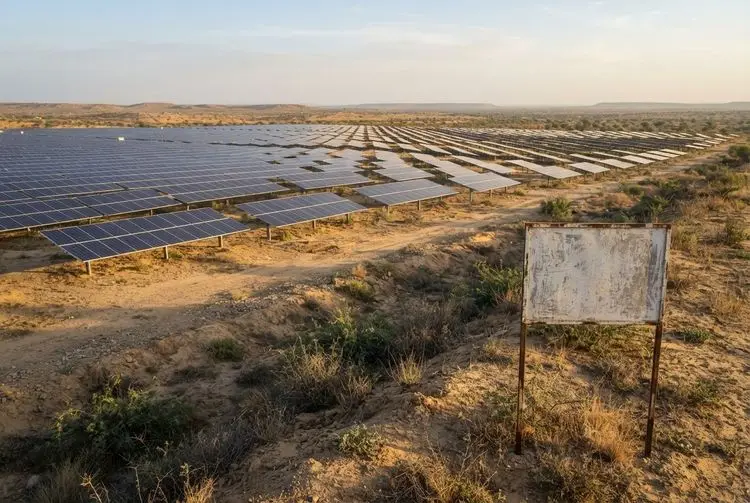
The Rajasthan government has made agricultural land conversion mandatory for all renewable energy projects, reversing a 2014 provision that had made the process optional for solar developers. The new rules, notified on September 29, 2026, took effect on November 2, 2026.
The Rajasthan Land Revenue (Use of Agricultural Land for Non-agricultural Purposes in Rural Areas) Rules, 2026, cover solar, wind, biomass, biogas, hydro, pumped storage and battery storage projects. Developers and landowners must now submit an online application to the sub-divisional officer to convert agricultural land for renewable energy use.
Reversal of the 2014 provision
The previous arrangement, introduced in 2014 under the Vasundhara Raje government, made land-use conversion optional for solar projects. Developers and landowners could seek conversion if needed — for instance, to secure bank financing — but projects without such requirements could keep the agricultural classification of the land.
Banks had been reluctant to lend against agricultural land used for industrial projects, which created financing hurdles for some developers. The optional conversion provision allowed projects to proceed without triggering land classification changes unless the developer specifically required it for loan approval.
The new rules eliminate that flexibility. All renewable energy projects on agricultural land in rural areas must now undergo formal conversion to non-agricultural use, regardless of whether the developer needs bank financing or not.
Penalties and charges
The rules set a land conversion charge exemption of 0.5% of the District Level Committee (DLC) rate. Developers who use agricultural land for renewable energy projects without authorisation face penalties of up to four times the prescribed premium.
The penalty structure is designed to enforce compliance. Unauthorised use of agricultural land for renewable energy projects will attract significant financial consequences, making the mandatory conversion process a non-negotiable step for project development in the state.
Impact on farmers and developers
Farmers leasing unproductive or barren agricultural land to solar developers may be affected by the change. Under the previous optional regime, landowners could lease land for solar projects without altering its agricultural classification, preserving certain rights and tax benefits associated with agricultural land.
The mandatory conversion requirement adds an administrative step that could affect project timelines. Developers will need to factor in the time required for the online application process and approval by the sub-divisional officer when planning project schedules.
For the solar industry, the change introduces a new regulatory requirement in one of India's most important renewable energy markets. Rajasthan has been a leading state for utility-scale solar deployment due to its high solar irradiation and large tracts of available land.
What it means for project economics
The 0.5% DLC rate exemption for conversion charges represents a relatively modest cost compared to total project expenditure. However, the administrative process and potential delays could have a more significant impact on project development timelines.
Developers who previously relied on the optional conversion provision to maintain agricultural land classification will need to adjust their land acquisition strategies. Projects in the pipeline that had not yet secured land conversion may need to revisit their regulatory compliance approach.
The penalty regime — up to four times the prescribed premium — creates a strong disincentive against bypassing the conversion process. Developers should ensure that all land used for renewable energy projects in Rajasthan undergoes the mandatory conversion process to avoid exposure to these penalties.
Industry context
Rajasthan has been at the forefront of India's renewable energy expansion, hosting some of the country's largest solar parks. The state's renewable energy policy has evolved significantly over the past decade, with regulatory frameworks adapting to the rapid growth of the sector.
The reversal of the 2014 provision signals a tightening of land-use regulation for renewable energy projects. Industry participants will need to monitor how sub-divisional officers process conversion applications and whether the online system operates efficiently enough to avoid bottlenecks.
For investors and project financiers, the mandatory conversion requirement may provide greater clarity on land classification, potentially addressing the bank lending concerns that had motivated the original optional provision. With formal conversion now required, lenders may have a clearer legal basis for financing projects on converted land.