
Peru Opens Consultation on Rural Solar System Technical Standard
MINEM's draft resolution sets module, battery and inverter specifications and a ten-year minimum warranty for rural electrification systems.
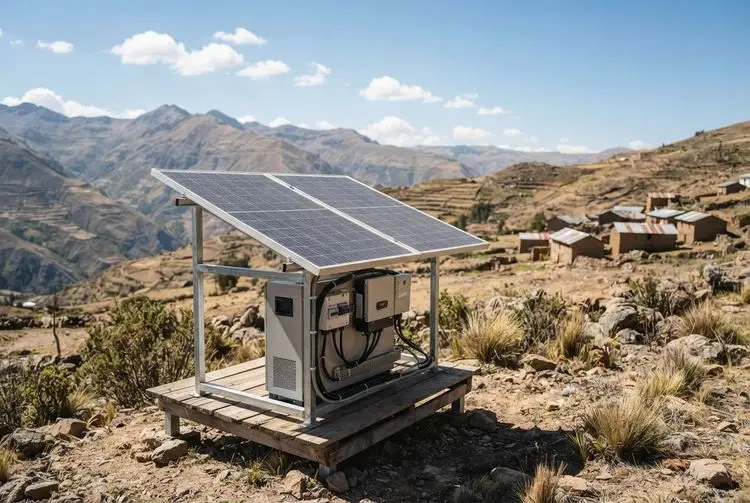
Peru's Ministry of Energy and Mines (MINEM) has published a draft Directoral Resolution setting technical specifications for photovoltaic (PV) systems, with the regulation covering rural electrification and other applications. The draft was issued through Ministerial Resolution No. 465-2026-MINEM/DM and is now open for public comment.
The ministry frames the proposal as an effort to align existing rules with technological advances while strengthening efficiency, safety and reliability requirements. It also seeks to widen energy access in rural areas of Peru, where standalone PV systems frequently serve as the primary source of electricity.
The draft carries the title "Technical Specifications of the Photovoltaic System and its components for Rural Electrification and other Applications." MINEM distributed the announcement in English through an automatic translation system.
Interested parties have 30 calendar days to submit comments, counted from the day after publication. Submissions can be filed at the MINEM filing desk at Avenida De Las Artes Sur No. 260, San Borja, Lima, or sent by email to Prepublicaciones_DGE@minem.gob.pe. The consultation is open to public and private entities as well as to the general public.
What the draft covers
The proposal adds technical specifications for the core components of a PV installation: modules, batteries, inverters, charge controllers, lamps, cables and connectors. Those specifications follow applicable national and international standards, according to the ministry.
Beyond individual components, the draft standardizes design and equipment selection criteria so that the parts assembled into a system are compatible with one another. It also sets uniform criteria for design, verification and commissioning, with those tasks carried out under licensed engineers. Equipment must be calibrated by accredited laboratories.
Ten-year warranty and broader applications
One of the more concrete provisions is a minimum ten-year warranty against manufacturing defects covering all components. The ministry says the goal is to optimize the use of public resources and to standardize quality and durability requirements across installations.
The scope of the regulation extends well past household electrification. Applications named in the draft include health centers, schools, water systems and productive enterprises — a signal that standalone PV is being treated as infrastructure for public services and local economic activity, not only as a source of basic lighting.
What to watch
For installers and equipment suppliers, the warranty clause and the laboratory calibration requirement are the elements most likely to shape procurement decisions. A ten-year defect warranty covering every component sets a floor that equipment selection will have to meet, and accredited calibration adds a documentation step that bidders will need to plan for. Both provisions point toward a market where traceable, standards-based components become the default for publicly backed rural projects.
The design and commissioning criteria matter for a different reason. Requiring licensed engineers to sign off on design, verification and commissioning creates a defined professional accountability chain from the drawing board to handover. For investors and development financiers, that kind of structure is typically easier to audit than arrangements where responsibility is diffuse.
The 30-day comment window is the practical opening for the industry. Component manufacturers, distributors, engineering firms and rural electrification operators can use it to flag specifications that may be hard to source, to clarify how the warranty obligation is expected to be enforced, and to test whether the compatibility requirements leave room for the equipment configurations already deployed in the field. Because the draft explicitly aims to standardize quality and durability, the definitions written into the final text will determine how much flexibility remains.
Peru's approach also offers a reference point for other markets weighing how to regulate small-scale PV for off-grid service. The combination of component-level specifications, a long minimum warranty and licensed engineering oversight is a package that touches cost, bankability and after-sales support at the same time. How MINEM balances those three in the final resolution will be worth tracking well beyond the comment period.