
SPONSORED

Solar and storage gain ground as global energy transition accelerates

EU funding, Brazil's long-term plan and a sobering Paris Agreement review shape the solar landscape.
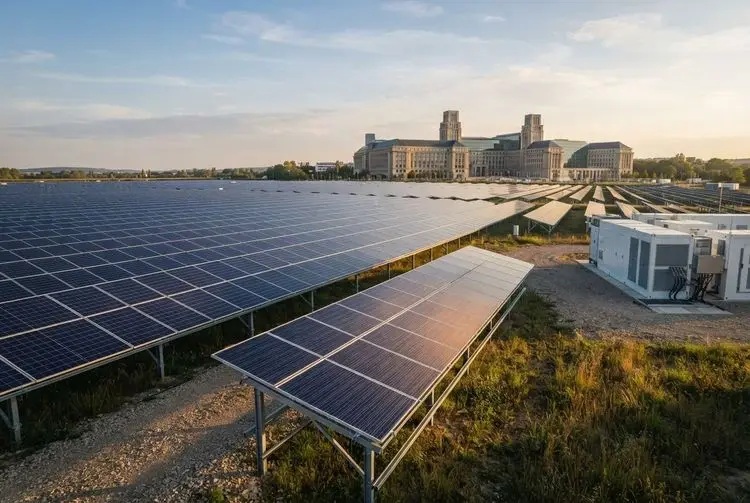
•• 6 Min
Solar and storage gain ground as global energy transition accelerates

Three developments across Europe, South America and the international climate stage this week illustrate the uneven but accelerating pace of the global energy transition. For solar industry professionals, the signals point to expanding financing mechanisms, growing policy support for battery storage, and a continued — if imperfect — multilateral framework that keeps renewable energy at the centre of national strategies.

EIB provides €100 million for Hungarian solar and efficiency projects

The European Investment Bank (EIB) is channelling €100 million through Eximbank Hungary (EXIM Hungary) to help Hungarian businesses invest in renewable energy, energy-efficient technologies and environmentally friendly infrastructure. The financing targets companies seeking to reduce electricity costs, modernise operations and lower carbon emissions.

Eligible investments under the programme include solar photovoltaic systems, energy-efficiency upgrades in factories, industrial facilities and commercial buildings, as well as electric vehicles and related charging infrastructure. The partnership aims to reduce businesses' dependence on fossil fuels, protect against energy price volatility and strengthen their competitiveness in domestic and international markets.

EIB Vice-President Marko Primorac described the clean energy transition as an opportunity for businesses to improve competitiveness and economic resilience. Zalán Kiss, CEO of EXIM Hungary, said sustainable business practices are increasingly important for economic viability and long-term competitiveness, extending beyond environmental concerns. The investment is expected to support Hungary's climate and energy objectives while improving energy security.

Access to affordable, long-term financing remains a critical barrier for many businesses, since major renewable energy and energy-saving projects often require substantial upfront spending. The EIB-Eximbank partnership directly addresses that gap for Hungarian companies.

Brazil approves National Energy Transition Plan with 2055 horizon

Brazil's National Council for Energy Policy (CNPE) approved the National Energy Transition Plan (Plante) on 6 November, establishing federal government guidelines for transforming the country's energy matrix over the coming decades. The plan aims to reduce dependence on fossil fuels and expand the share of clean sources.

A central challenge is the projected growth in energy demand, which could increase nearly fourfold by 2055. Plante sets strategies to ensure this expansion is accompanied by lower greenhouse gas emission sources and to prepare energy infrastructure for new economic demands such as data centers and artificial intelligence.

The plan will be divided into two volumes: the first presents a long-term strategic vision, while the second details implementation cycles organised in four-year periods. It will serve as a reference to integrate public policies and energy sector initiatives, drawing on planning instruments from the Ministry of Mines and Energy (MME) and the Energy Research Company (EPE).

Expanding electricity transmission infrastructure is a priority to enable the flow of renewable generation, especially in regions with a high concentration of generation projects. Brazil has already accumulated R$ 80 billion in investments in the energy transition context, with advances in transmission line expansion.

For solar and storage professionals, a key milestone is the first Brazilian auction for contracting battery energy storage systems (BESS), scheduled for December 2026. The auction aims to increase flexibility and reliability of the electrical system and facilitate the integration of intermittent sources like solar and wind.

The approval of Plante occurs shortly before President Lula's participation in COP31 in Antalya, Turkey, where the Brazilian delegation intends to present advances since COP30 in Belém. With Plante, the federal government now has a long-term planning instrument to guide energy sector actions until 2055, articulating supply expansion, infrastructure, energy security and emission reduction.

Paris Agreement at ten years: missed targets but continued relevance

A comprehensive analysis by The Guardian marks ten years since the Paris treaty with a sobering assessment. The agreement's key temperature goal of limiting global heating to 1.5°C above preindustrial levels has been missed, with temperatures exceeding that threshold for two years and the UN estimating 1.7–1.8°C of heating.

The rate of temperature rise has accelerated from 0.2°C per decade in 2015 to 0.4°C per decade today and is still accelerating, making the slow Paris timetable increasingly inadequate. The US, responsible for about one in every eight tonnes of CO2 emitted today, has withdrawn from Paris under President Trump. Even supportive developed countries have failed to produce convincing plans: Australia has set no end to fossil fuel exports, Turkey plans to increase carbon output, the UK is opening a gasfield, Germany dropped EV sales targets and scrapped a renewable heating law, and rich countries are reducing climate finance contributions.

Ahead of the 2025 climate summit in Belém, Brazil removed concrete national emissions-cutting plans from the negotiating table, insisting they were the business of national governments rather than for negotiation. The consensus requirement for all resolutions has given bad actors free rein, with Trump allies in Saudi Arabia, Russia, Venezuela and other petrostates frequently vetoing measures. It took more than 30 years of negotiation since the 1992 UN framework convention for fossil fuels to even be addressed directly, at COP28 in Dubai in 2023, where countries agreed to 'transition away from fossil fuels' but set no timeframe or policies.

Real-world progress continues despite diplomatic gridlock

Despite the diplomatic failures, significant progress is underway on the ground. Nearly 60 countries held an alternative meeting in Colombia in April after COP30's failure to provide a strong fossil fuel phase-out statement, agreeing to draw up their own national roadmaps for transitioning away from fossil fuels. France, Germany and the Netherlands have already done so.

Cutting methane by 40% could hold down temperatures by about 0.3°C in the next decade, with deeper cuts yielding a 0.5°C decrease by 2100. China is taking multilateral climate efforts more seriously because its economic stakes have grown enormously, particularly in selling solar panels and electric vehicles.

Developing-country consumers are adopting clean technology without waiting for assistance: rooftop solar makes up about a quarter of Pakistan's electricity use, and Chinese EVs account for more than 40% of Vietnam's car sales.

Electrification is presented as a major opportunity, with a proposed COP31 target of deriving 35% of final energy use from electricity by 2035, up from 23% today. Experts including Johan Rockström and Juan Carlos Monterrey acknowledge Paris has failed on its temperature goal but insist it remains 'all we have' and serves as a vital 'moral compass' setting direction for climate action.

What this means for solar industry professionals

Across these three developments, a common thread emerges: the energy transition is advancing through a combination of targeted financial mechanisms, national planning and multilateral pressure, even as the pace remains insufficient to meet the most ambitious climate goals.

For solar industry professionals, installers, investors and engaged homeowners, the signals are clear. Policy support and financing mechanisms are expanding in key markets. Battery storage is becoming a strategic priority, as Brazil's 2026 BESS auction demonstrates. And the electrification of energy use — particularly through solar and EVs — is accelerating even where international diplomacy stalls. The challenge remains scaling these efforts fast enough to bend the emissions curve.

Eib Hungary SolarBrazil Plante Energy TransitionParis Agreement Cop31Battery Storage Brazil 2026Solar Pv FinancingGlobal Energy TransitionRenewable Energy Policy

Most Popular News

  1. India adds 11.2 GW rooftop solar in nine months, up 127.5%
  2. PVT collector with graphite-paraffin storage achieves 48.7% efficiency
  3. Flexell Space and ALATYR partner on solar for orbital data centers
  4. Konya province now hosts 10% of Türkiye's total solar capacity
  5. Tungsten wire scrap value rises as PV production cuts reshape supply chains

Disclaimer


Important notice regarding existing conflicts of interest:

We expressly point out that conflicts of interest exist in connection with this publication:

1. Stock Market Media Ltd. and persons closely associated with it hold shares in the companies recommended here and intend to sell them within the scope of, and at any time during, this recommendation. This constitutes a clear and specific conflict of interest.

2. The publisher of this publication and the responsible editors receive financial remuneration for its preparation. This, too, constitutes a clear and specific conflict of interest.

3. Please also note the further statements on existing conflicts of interest in the disclaimer below, inter alia under no. 2.

Important information and mandatory disclosures pursuant to the German Securities Trading Act (Wertpapierhandelsgesetz, WpHG) and pursuant to the German Financial Investment Ordinance (Finanzanlageverordnung, FinAnV).

Stock Market Media Ltd. has notified the German Federal Financial Supervisory Authority (Bundesanstalt für Finanzdienstleistungsaufsicht, “BaFin”), pursuant to the WpHG, of its activity as a producer of investment strategy recommendations within the meaning of Article 3(1) point 34 of Regulation (EU) No 596/2014 or of investment recommendations within the meaning of Article 3(1) point 35 of Regulation (EU) No 596/2014 (formerly “financial analyses”). The obligations of Stock Market Media Ltd. are governed primarily by §§ 85, 86 WpHG, Regulation (EU) No 596/2014 and Delegated Regulation (EU) 2016/958.

Information on the producer(s) of this publication:
Mr Roberto Gonçalves de Albuquerque, as analyst and editor-in-chief, is responsible for the preparation of the texts and contents of this publication. The publisher is Stock Market Media Ltd., 405 Kings Road, Flat 600, London; SW10 0BB, United Kingdom, represented by its Director Roberto Gonçalves de Albuquerque.

Important notes on the preparation of this publication:
This publication contains both facts and factual information on the companies discussed and purely subjective value judgements, interpretations, estimates, projections, forecasts and price targets. We endeavour to distinguish these from one another as transparently as possible in order to avoid misleading statements. Research, preparation and wording are carried out using common digital and AI-supported tools; the review of the content and the editorial responsibility lie with us. The essential bases and standards of our value judgements and valuations of the shares discussed are based on the following approach:

Assessment and valuation of companies according to conventional valuation methods (fundamental valuation approach)

  • Assessment of the potential of the company's future development (growth approach) and projection onto the corresponding valuation potential (price potential analysis) as well as a possible valuation of the company's shares on the basis of potential profit expectations (P/E ratio projection)
  • Assessment of the best-case scenario expected by us in the event of the company's absolute success (blue-sky potential approach)
  • Effect on the share price of the increased awareness of the recommended share expected by us, resulting from a strong rise in demand on the market (particularly decisive in the case of illiquid shares or shares recommended newly or for the first time) on account of the publications (mostly buy recommendations) published by us or by third parties (multiplier / momentum effect, hype), and thereby a disproportionately rising return/share price with a correspondingly rising risk
  • Technical analysis of the share price in accordance with common methods of analysis, mostly for the prediction of price signals (buy or sell signal, breakout of the share, determination of price targets, support or resistance areas, expected minimum movements or minimum counter-movements, prediction of signal points (if-then), etc.), for the most part building on the expected mass psychology (technical approach).

Conventional valuation approaches often cannot be meaningfully applied to young companies or companies that do not yet generate revenue. In valuing such companies we therefore tend to rely on the potential analysis calculated by us and on the assessment of the demand for such shares on the capital market. Ultimately, the market decides on the share price of a company. If extensive recommendations of a share give rise to excessive demand for it, it is possible that the share price will rise at an above-average rate on high trading volume. Although this leads to extreme opportunities for profit, it correspondingly increases the risk of a bubble forming, with a corresponding fall in price. The increased volatility of the share in such situations gives rise to above-average opportunities for profit and loss, both in both trading directions and in the case of recurring counter-movements. Such market developments are also an important part of our trading recommendations and valuation approaches.

This publication deals exclusively with securities of above-average volatility with high potential for profit and also for loss.

Note on sources of information:
The reliability of sources of information is examined by us in detail before they are used and is subjectively assessed by us according to their credibility and significance. In doing so, we decide by our own standards which sources we consider relevant, too conservative or too optimistic. Ultimately, we determine our recommendations on the basis of our personal assessments. In obtaining information we draw on numerous publicly accessible sources such as press releases, ad hoc announcements, company announcements, company presentations, publications and articles on the company discussed, common financial media in Germany and abroad as well as company or sector analyses by third parties.

Our publications use exclusively publicly available information and sources as well as information disseminated by the company itself.

Note on existing conflicts of interest:
We hereby point out that shareholders, editors, employees and persons or companies involved in the preparation of this publication, as well as principals (third parties) commissioning the publication of Stock Market Media Ltd., hold, directly or indirectly, at the time of this publication, interests in securities which are discussed in the respective publication, and are therefore interested in an increase in price and/or turnover, i.e. also in increased trading liquidity, since it is intended to sell these securities in direct connection with this publication and to participate in rising prices and turnover. An increase in the price of the shares of the companies presented may lead to an increase in the assets of these persons. In any case, the share price of the company may be significantly influenced by the discussion of the company. In particular, the share price of the companies discussed is also materially influenced by securities transactions. This applies in particular where the companies concerned are ones whose shares do not have a broad market capitalisation and for which only a narrow market exists. Here, even small order volumes can have considerable effects on prices. However, they are also interested in the price of the company discussed falling if they wish to acquire its shares more cheaply. By law, this gives rise to a conflict of interest, to which we hereby expressly draw attention.

Stock Market Media Ltd. and its employees are furthermore remunerated for the preparation, electronic distribution and publication of this publication as well as for other services. By law, this gives rise to a conflict of interest, to which we hereby expressly draw attention.

This remuneration may be paid by the company about which Stock Market Media Ltd. publishes information, by third parties affiliated with these companies or by other third parties pursuing an interest with regard to the companies discussed in connection with this publication. By law, this gives rise to a conflict of interest, to which we hereby expressly draw attention. This arises, first of all, from the fact that Stock Market Media Ltd. could make its statements in the interest of its principal. Stock Market Media Ltd. and/or companies affiliated with it have entered into an agreement, for a fee, with the company in question or with its shareholders for the preparation of the editorial coverage. By law, this gives rise to a conflict of interest, to which we hereby expressly draw attention.

Note on the handling of internal organisational duties:
Owing to the small size of the publisher's business, internal control of the compliance processes of the employees and other parties contributing to this publication is limited.

Competent supervisory authority:
Stock Market Media Ltd. has notified BaFin of its activity pursuant to § 86 WpHG.