
Malaysia's off-grid solar push reaches Orang Asli village at US$4,930 per home
Kampung Bertang villagers gain solar access, but cost and maintenance hurdles remain for Malaysia's remote communities.
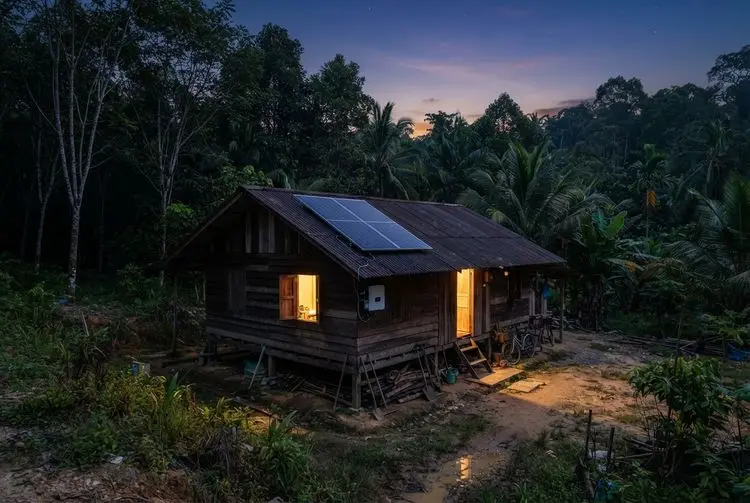
Kampung Bertang, a remote Orang Asli village 170km from Kuala Lumpur, received solar power in April — ending years of reliance on kerosene and cooking oil for lighting. The project, delivered by Bright Spots Energy and SHER Engineering with funding from Yayasan Hasanah, now serves more than 500 Orang Asli residents.
Households pay US$7 per month into a community fund for system upkeep. But the economics remain challenging: each off-grid solar installation costs approximately US$4,930 per household, and battery replacements due within five years exceed US$980 per system.
"We are happy with the light we have at night. The kids can read at night now. We only use one light and that is enough for them," said Osman Uki, a resident of Kampung Bertang in Pahang.
Nearly 200 Orang Asli villages across Malaysia still lack access to the national grid. Previous off-grid solar installations in similar communities failed within one to two years, according to Yeap Mei Yi of Bright Spots Energy.
"It's very, very common to see a solar project that is built, installed and then within a year or two, it's not working and abandoned because nobody knows how to do maintenance and operations," Yeap said.
Villagers pool earnings from rubber tapping and fruit harvesting to meet the monthly community fund contributions. The model aims to create a sustainable operations and maintenance cycle — a critical gap that has undermined earlier electrification efforts.
Malaysia's energy transition context
Malaysia targets net-zero emissions by 2050, a goal underpinned by the National Energy Transition Roadmap released in 2023. In September, the government raised the electricity consumption exemption threshold from 600kWh to 800kWh per month, a measure Prime Minister Anwar Ibrahim framed as a cost-of-living relief for households.
The Kampung Bertang project illustrates the scale of investment needed to extend clean energy access to off-grid populations. At roughly US$4,930 per household, electrifying the nearly 200 unelectrified Orang Asli villages would require millions of dollars in upfront capital — before accounting for battery replacement costs every five years.
Southeast Asia's broader affordability challenge
The affordability gap extends well beyond Malaysia. Across Southeast Asia, the transition to clean energy risks creating a two-tier energy system, warned Renard Siew of Yinson.
"There is a real risk that the transition creates a two-tier energy system: those who can afford to decarbonise and those who continue paying the price of not being able to," Siew said.
In the Philippines, 74% of electricity generation came from coal and natural gas in 2025, according to the Centre for Energy, Ecology and Development (CEED), a Manila-based think tank. Low-income Filipino households consume roughly 60kWh per month, while middle-income households use about 210kWh. A basic 500W rooftop solar system costs US$437 and saves households approximately US$5 per month — a payback period that remains out of reach for many without financing support.
Grid operators in the region may raise tariffs to fund infrastructure upgrades, while fuel subsidy reforms could affect transport and food costs, compounding pressure on low-income households.
Investment needs and climate finance
The International Energy Agency's World Energy Investment 2025 report estimates clean-energy investment in Southeast Asia at US$47 billion in 2025. But the region needs roughly US$100 billion per year from 2026 to 2030 to align with climate goals, according to analysts tracking the gap.
At Cop29, developed nations agreed to mobilise climate finance, with a goal of US$300 billion per year by 2035. Cop31 opens in Antalya, Turkey on Monday, where implementation and access to those funds will be a central topic.
Anjali Viswamohanan of the Asia Investor Group on Climate Change has urged investors to assess community benefits as part of due diligence on clean-energy projects. Gerry Arances of CEED has highlighted that without deliberate policy design, the cheapest financing and best technology will flow to higher-income segments first.
For solar industry professionals and investors, the Kampung Bertang project offers a real-world case study in the operational challenges of decentralised solar. Battery replacement costs, community payment models and local maintenance capacity are not peripheral issues — they determine whether off-grid systems last five years or fail in two.