
Mesa Grande solar project powers tribal housing revival in California
Solar+battery systems on three buildings mark first public clean-energy installation for Mesa Grande Band.
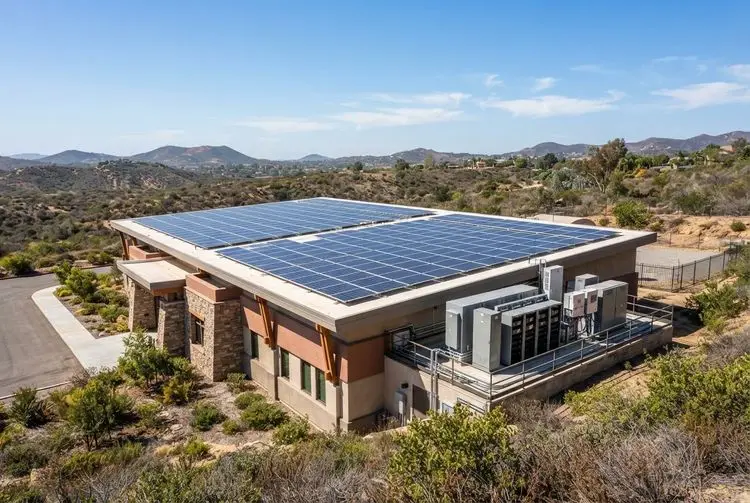
The Mesa Grande Band of Diegueño Mission Indians has completed its first public clean-energy installation, pairing solar photovoltaic and battery storage systems on three administration buildings as the tribe pursues a long-term housing development plan on its reservation in San Diego County.
The solar-plus-storage systems installed at the Tekamuk, Hallyeyaaw and Golden Eagle administration buildings are expected to generate approximately 60 MWh of electricity annually and save the tribe at least $16,780 per year in electricity costs. The project is part of a broader push by Mesa Grande to increase self-determination and resilience while working toward a net-zero energy footprint.
Housing crisis drives development
No new home has been built on the Mesa Grande reservation since the early 2000s. The Mesa Grande Indian Housing Authority currently manages 22 rental homes, constructed in 1995 and 2000, while roughly 50 people sit on a housing waitlist that continues to grow. Many tribal members live with relatives or off the reservation because of high housing costs in the San Diego region.
"Historically, tribal citizens were encouraged to build lives elsewhere due to limited housing, infrastructure and economic opportunities," according to background provided by the tribe. The new housing master plan envisions up to 150 homes over multiple phases, beginning with North Field Phase 1A, which plans 12 units on the Golden Eagle property. Under the California Tribal Homekey program, the first 12 homes must be completed by spring 2028.
Danielle LaChusa, housing director for the tribe, said: "This is going to have such a huge impact."
Funding stack supports solar and housing
The housing initiative received a $12.432 million Tribal Homekey award on December 4, 2025, comprising $12 million in capital funding and $432,000 in operating subsidies. An $800,000 grant from the San Diego Association of Governments (SANDAG) REAP 2.0 program supported planning, development and community engagement. In addition, the California Strategic Growth Council awarded approximately $3 million from its Tribal Housing Pre-Development Fund on October 30.
The solar installation was designed and coordinated with help from the Solar Electric Light Fund (SELF), a nonprofit that assisted with fundraising and project management. Four tribal members with prior solar training were employed on the project. The William, Jeff and Jennifer Gross Family Foundation and other donors provided financial support. Sovereignty Construction, a Native-owned firm based on the Cahuilla Indian Reservation, serves as owner's representative and construction manager.
What the solar project means for tribal energy
For solar industry professionals, the Mesa Grande project illustrates a growing model: pairing distributed solar and battery storage with affordable housing development on tribal lands. The systems on the three administration buildings provide immediate operational savings — roughly $16,780 per year — that can be redirected toward infrastructure and housing needs. The 60 MWh annual generation figure, while modest in utility-scale terms, represents meaningful energy cost relief for a community that historically lacked basic electricity infrastructure.
Curtis La Chusa, chairman of the Mesa Grande Band of Diegueño Mission Indians, described the conditions that preceded the current development push: "There was no electricity, there was no opportunity, there was no education. There was nothing here for anyone."
The solar project also creates a foundation for future phases. Infrastructure improvements on undeveloped land will be needed to support additional housing beyond the initial 12 units. Each subsequent phase of the housing master plan will require similar energy planning, potentially opening opportunities for community solar, microgrid configurations or additional behind-the-meter storage deployments.
Long-term vision
The tribe's goal of reaching net-zero energy status aligns with broader trends in tribal renewable energy development across the western United States. Federal and state programs, including the Tribal Homekey initiative and California's Strategic Growth Council funding, are increasingly targeting integrated energy and housing solutions for tribal communities.
La Chusa added: "The Mesa Grande Indian did not die; we're not extinct. We are still here."
The combination of solar generation, battery storage and new housing construction positions Mesa Grande to address both its energy costs and its housing shortage simultaneously — a dual challenge that many rural and tribal communities across the country are beginning to tackle with similar integrated approaches.