
UAE to Lead Per-Capita Solar Generation by 2031 as China Tops CSP Rankings
IEA projects UAE solar output per capita above 4,000 kWh as China surpasses Spain in concentrating solar capacity.
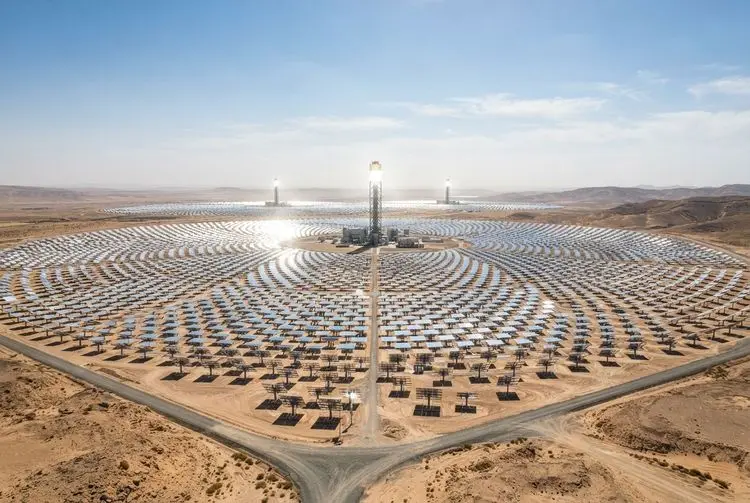
The United Arab Emirates is on track to become the world's largest generator of solar electricity on a per-capita basis by 2031, while China has overtaken Spain in installed concentrating solar power (CSP) capacity, according to two reports published this week that underscore the accelerating global solar expansion.
The International Energy Agency's 2026 Renewables report projects that UAE solar power generation per capita will exceed 4,000 kilowatt-hours within the next six years. The Paris-based agency places the UAE at the top of a global ranking that includes several other Middle Eastern nations, with Oman ranking third and Qatar fifth in per-capita solar generation. Australia places second, followed by Bulgaria in fourth position. Greece, Austria, Spain, China and Chile complete the top 10.
All countries in the top 10 are expected to generate at least 2,000 kWh per capita by 2031, well above the global average of approximately 800 kWh, the IEA said. While global average per-capita solar output is projected to more than double by 2031, leading countries will still generate multiple times that average, highlighting persistent disparities in deployment rates and access to solar generation.
Solar power is expected to account for approximately three-quarters of the world's total renewable electricity capacity, which is projected to increase by nearly 85 percent by 2031, according to the IEA.
Middle East renewable capacity set to triple
The Middle East as a whole is set to triple its renewable energy capacity through 2031, a trajectory the IEA also forecasts for Africa and Southeast Asia. Saudi Arabia is expected to boost its renewable energy expansion fivefold during the same period, followed by the UAE, marking what the agency describes as a structural step-change in the region's energy market.
The IEA attributed the accelerated forecast to new ambitions, energy security benefits, supportive policies and the growing competitiveness of wind and solar photovoltaic technology. These factors have raised the forecast for emerging and developing economies by almost 20 percent compared with the agency's previous year's report.
Globally, renewable energy market capacity is projected to reach nearly 4,800 gigawatts between 2026 and 2031, representing a 57 percent increase compared with the previous six-year period. China is expected to remain the largest market, with India rising to second place.
The UAE has continued to champion renewable energy as part of its economic diversification efforts. At September's Middle East Energy summit, Energy and Infrastructure Minister Suhail Al Mazrouei said the country had boosted its clean energy target — covering both renewables and nuclear — to 35 percent by 2030 to 2031. Achieving that target will require new projects, stronger competition and broader opportunities for the private sector in power generation, Al Mazrouei said.
China surpasses Spain in CSP capacity
In a separate development, China has overtaken Spain in installed concentrating solar power capacity, according to the China Solar Thermal Alliance. The country now has 2,438 megawatts of CSP installed.
This milestone coincided with the connection of the first unit of a novel solar thermal plant in Xizang (Tibet). China General Nuclear Power Group (CGN) connected the first 25-megawatt turbine unit of its 50-MW solar thermal power plant in Ngari prefecture to the grid on November 6.
The facility, located in Gar County at an average altitude of 4,300 meters, is described by CGN as the world's highest grid-connected solar thermal plant and Xizang's first grid-connected solar thermal project.
Unlike conventional concentrating solar power plants, the Ngari facility has no mirror field. Instead, off-grid solar panels power molten-salt electric heaters rated at 205 megawatts, which CGN says is the largest such heater at any solar thermal plant. The heated salt stores energy for 14 hours and raises steam for turbines after sunset. A lithium-ion battery link allows the plant to switch between grid and stand-alone operation.
The thermal plant is part of a 150-MW project with total investment of approximately CNY 2.4 billion ($357 million). The project includes a 100-MW photovoltaic station that is already fully connected. Construction of the thermal section began in July 2024.
EPC contractor PowerChina Zhongnan Engineering said unit 1 synchronized at 00:22 local time after its turbine first rolled on August 26. The plant holds 29,500 tons of molten salt, providing 14 hours of heat storage — equivalent to roughly 700 MWh of storage at nameplate output, according to a list.solar calculation. Investment is approximately CNY 16 million per MW of grid capacity.
Once fully built, the project is expected to produce approximately 270 GWh of power annually, cutting CO2 emissions by about 168,200 tons, according to CGN. The stored heat will also supply district heating in Shiquanhe town.
Tan Xiangfeng, head of the Ngari energy bureau, said it was the first integrated PV and solar thermal project approved in Xizang. Unit 2 is scheduled to connect to the grid by the end of 2026.
The Ngari facility functions as long-duration energy storage fed by photovoltaic power rather than a conventional mirror-based CSP plant. It differs from mirror-based plants such as the 100-MW Fukang tower in Xinjiang and the 350-MW Delingha project in Qinghai, which remains under construction.
Divergent but complementary trends
The two reports highlight different but complementary trajectories in global solar development. The IEA data emphasizes the rapid expansion of solar photovoltaic deployment, particularly in the Middle East, driven by favorable policies and economic diversification strategies. Meanwhile, China's CSP milestone illustrates continued innovation in energy storage technologies that address the intermittency challenges inherent in solar power generation.
Spain's displacement from the top position in CSP capacity marks a significant shift in the global concentrating solar market, where China has now established leadership through both mirror-based and alternative thermal storage approaches. The Ngari project's use of electric heaters powered by off-grid solar panels represents a departure from traditional CSP designs, potentially offering a more flexible model for high-altitude or remote locations where conventional mirror fields may face operational challenges.