
Array Technologies and Shoals Merge in $1.32B All-Stock Deal
Combined solar infrastructure platform unites trackers with electrical balance-of-system hardware.
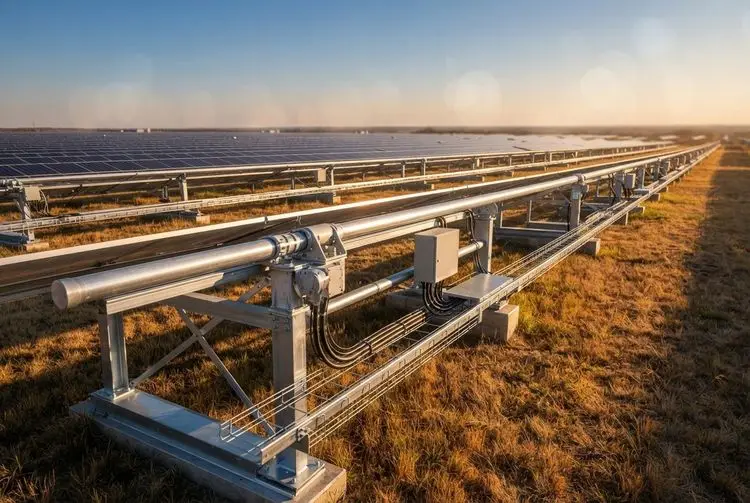
Array Technologies and Shoals Technologies Group have signed a definitive agreement to merge in an all-stock transaction valued at approximately $1.32 billion. The deal creates an integrated energy infrastructure platform that spans structural and electrical balance-of-system (eBOS) solutions for utility-scale solar PV and battery storage.
The merger unites ARRAY's single-axis trackers and fixed-tilt mounting systems with Shoals' electrical power delivery, wire management, and combiner box hardware. Although structural foundation systems and electrical infrastructure must integrate seamlessly on utility-scale solar and storage projects, the two product categories have traditionally been designed, specified, and procured through separate supply chains.
By consolidating both technology suites under one roof, the combined company plans to deliver pre-integrated equipment packages, streamlined purchasing, and single-source warranty support across foundation, racking, and electrical systems. The company stated that the unified engineering approach is designed to eliminate site-level integration friction, cut field installation labor, and improve system reliability over the operational life of utility-scale assets.
Deal Structure and Ownership
Under the terms of the merger agreement, ARRAY will act as the legal acquirer and parent company. Shoals shareholders will receive 1.6931 ARRAY shares for each Shoals share and will own approximately 65% of the enlarged company, with ARRAY holders owning about 35% on a basic share basis. On a fully diluted basis, the split is 64.5% to Shoals holders and 35.5% to ARRAY holders.
The combined business plans to launch a new corporate brand name and stock ticker symbol prior to closing, with an announcement due in the coming months.
Brandon Moss, current chief executive officer of Shoals, will lead the combined company as CEO. Kevin Hostetler, chief executive officer of ARRAY, will transition to a role as special advisor. Brad Forth, who currently serves as chairman of the board for both companies, will serve as chairman of the combined 10-member board, which will include four independent directors from each side.
"This transaction represents a compelling opportunity to create meaningful value for customers of both ARRAY and Shoals by bringing together our complementary strengths," Hostetler said.
Financial Projections and Synergies
The combined platform projects full-year 2027 pro forma revenue between $2.2 billion and $2.4 billion, with Adjusted EBITDA estimated at $410 million to $480 million, including year-one synergies, in preliminary estimates. This represents approximately 19.3% adjusted EBITDA margin at the midpoints of the 2027 ranges, according to a list.solar calculation. The projected 2027 revenue midpoint of $2.3 billion is 12.5% above the $2.05 billion midpoint of the two companies' combined 2026 revenue guidance, per list.solar calculations.
The companies also expect to capture more than $100 million in annual run-rate EBITDA cost synergies within three years.
As part of the transaction, $317.5 million of ARRAY's Series A preferred stock will be redeemed, starting with $161.3 million within 90 days of closing.
Recent Quarterly Results Diverge
The deal landed alongside quarterly results that pointed in opposite directions. Shoals said third-quarter revenue rose 43.8% to $195.3 million and raised its 2026 outlook. ARRAY's revenue fell 16.1% to $330.2 million, and it cut its full-year guidance to $1.34 billion to $1.40 billion, even as its orderbook hit a record $2.6 billion. Combined third-quarter revenue reported by the two companies totaled $525.5 million, according to a list.solar calculation.
Strategic Expansion Beyond Traditional Solar
Beyond traditional solar and storage projects, the combined entity aims to leverage its technical portfolio to expand into high-growth power infrastructure segments, including long-duration energy storage and data center power delivery systems. The merged group plans to push into battery storage and data center infrastructure. Last month, ARRAY added automated hail alerts for its Australian trackers.
The deal has been approved by the voting members of both corporate boards. The merger requires approval from shareholders of both Nasdaq-listed companies, regulatory clearances, and a Nasdaq listing for the new shares. The transaction is expected to close in the first quarter of 2027, subject to shareholder and regulatory approvals.
Industry Context: Calls for Innovation Beyond Scaling
The merger comes as industry leaders emphasize the need for technological innovation in the solar sector. In a separate interview with ETEnergyWorld at the Bharat Renewable Energy Summit and Expo 2026 in New Delhi, Sujoy Ghosh, Country Managing Director of First Solar, said India needs to move beyond scaling existing solar manufacturing technologies and focus on developing indigenous technologies and intellectual property.
"Right now, all the capacity expansion is scaling up technologies that are already commercialised in China," Ghosh said. "There is a lot of dependency on the Chinese ecosystem, whether with respect to materials like wafers, ingots and polysilicon, or the capital equipment required to manufacture solar panels. Going forward, having created the scale, the Indian industry has to focus on innovation and start creating technologies where we control the entire value chain."
Ghosh highlighted the advantages of First Solar's thin-film technology compared to crystalline silicon. "Thin film uses a very differentiated production process. We take a sheet of glass and deposit a semiconductor on it at high temperature, converting that sheet of glass into a module in four hours," he said. He added that thin-film modules generally perform better than silicon modules in hot and humid environments.
"Anywhere between the two tropics, a cadmium telluride thin-film module is going to produce higher lifetime energy than comparable crystalline silicon technology," Ghosh said.
On reducing import dependence, Ghosh emphasized innovation in the technology stack, including research into perovskites as alternative thin-film materials. He noted that First Solar is deepening its collaboration with Indian academia and supporting startups developing perovskite technology, while also upgrading its own manufacturing facility near Chennai with an additional $150 million investment.
The merger between Array Technologies and Shoals Technologies Group marks a significant consolidation in the solar balance-of-system market, bringing together two publicly listed suppliers that together reported $525.5 million in combined third-quarter revenue. The combined entity will serve utility-scale solar developers and EPC contractors with a fully integrated hardware offering that previously required separate procurement and coordination across two supply chains.