
PPC Solar Donates 7.5-kW System to Ojo Sarco Community Center
A donated solar-plus-storage system brings backup power to a remote New Mexico community center.
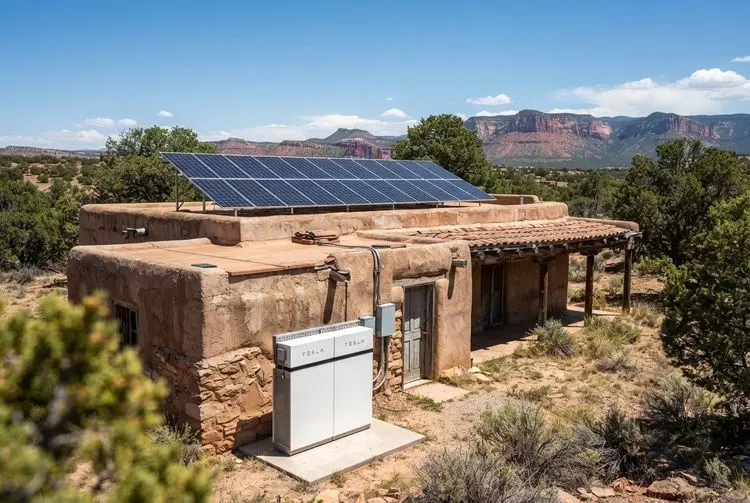
PPC Solar has completed a donated 7.5-kW photovoltaic array paired with 10.6-kWh lithium iron phosphate (LFP) battery storage at the Ojo Sarco Community Center (OSCC) in rural New Mexico. The system was installed at no cost to the community center and provides partial facility backup through a critical loads panel.
The project was built in fall 2025. The Ojo Sarco Community Center had applied for the donation three years before being awarded the system.
Ojo Sarco is an unincorporated community of roughly 300 residents, located 43 miles northeast of Santa Fe. The community center began as a one-room schoolhouse in the early 20th century and has since evolved into a vital hub for the area.
A Community Without a Voice
Carol Miller, grant writer and OSCC board member, described the challenges facing the remote settlement. "We have no political voice, really. We're pretty neglected. We've lost resources in the past. We were the first wave of people to lose our post office many years ago. Everybody has to commute pretty much for everything."
Residents travel roughly 40 minutes round trip to access basic amenities. The community lost its post office years ago, leaving it without a dedicated federal service point.
The OSCC now fills multiple roles. It operates a food bank, provides summer meal programs for children, hosts safety classes and organizes community outings. The center recently qualified as a state library, adding another layer of service for residents.
A Decade-Long Donation Tradition
PPC Solar — formally Paradise Power Company — is based in Taos, New Mexico. CEO Daniel Weinman's father founded the company in the 1970s as a solar pioneer. Weinman noted that his own family home had no electricity until solar was installed.
The company's annual nonprofit donation program has been running for over a decade. "The best thing that we found — and we've been doing it for over a decade now — is doing an annual nonprofit donation system," Weinman said. "We've had farming organizations, land conservation organizations, and it goes on and on. Really, it's about finding the right fit. We wanted to make a good impact for this community center, and we felt resiliency was the best way to do that."
The donation program grew out of the off-grid solar tradition that shaped the company's early work. Weinman's father brought solar power to places that had no grid access, a legacy that continues with each annual donation.
Resiliency Through Solar and Storage
The 7.5-kW array and 10.6-kWh LFP battery system are configured to back up critical loads at the community center. This setup ensures that essential services — such as food bank operations, library functions and emergency preparedness — can continue during grid outages.
For rural, unincorporated communities like Ojo Sarco, energy resiliency is particularly valuable. Without a municipal government or formal political representation, these areas often face longer wait times for grid repairs and infrastructure upgrades. A solar-plus-storage system provides a degree of energy independence that larger, incorporated towns may take for granted.
LFP battery chemistry, used in this project, offers advantages for stationary storage applications. It provides a longer cycle life and better thermal stability compared to other lithium-ion chemistries, making it well-suited for community-scale backup systems in remote locations.
Carol Miller emphasized the broader impact of the donation. "Any technology that is shared equally in a low-income community has ripple effects beyond what I think some of us imagined a number of years ago. It's for everyone."
The project was managed by Preston Bastardo of PPC Solar, with support from Larry Miller and other community members.
For solar industry professionals, the Ojo Sarco project illustrates a growing trend: targeted donations of small-scale solar-plus-storage systems to rural community facilities. These installations serve as real-world demonstrations of resiliency technology while providing tangible benefits to underserved populations. The combination of a modest 7.5-kW array with a 10.6-kWh battery represents a configuration that can be replicated at similar community centers across the United States.
PPC Solar's model of donating one system per year to a regional nonprofit also offers a template for other solar installers looking to structure community outreach programs. By selecting applicants through an application process — the OSCC waited three years — the company ensures that each donation reaches a facility where it will have maximum impact.