
Why C-Parts Matter More Than Solar Project Planners Think
Small components like cable ties and connectors often get overlooked — but cause major problems later.
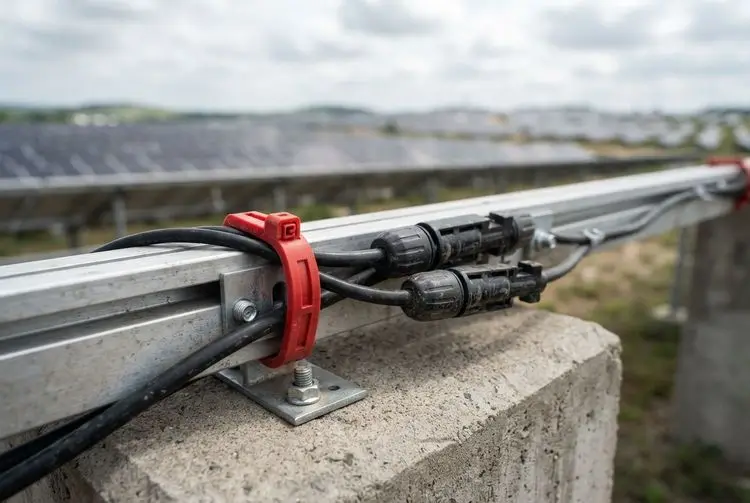
Solar project business traditionally revolves around the big-ticket items: modules, inverters and mounting systems. These components dominate procurement lists, budgets and delivery schedules. Yet a lesser-known category — so-called C-parts — frequently receives far less attention, despite playing a critical role in project completion and long-term reliability.
C-parts are the small components that make a solar installation functional and safe. They include cable ties, connectors, protective conduits and similar hardware. Individually, each part costs little and seems insignificant. Collectively, however, they are indispensable. An oversight in ordering or specifying these parts can delay commissioning, create safety hazards or lead to costly retrofits.
The topic was recently discussed in a CEO Talk format hosted by pv Europe and Alfons W. Gentner Verlag GmbH & Co. KG. Industry experts noted that C-parts are often neglected in the project business, even though oversights of these small parts cause problems later.
Why C-Parts Get Overlooked
The tendency to focus on high-value, high-visibility components is understandable. Modules, inverters and mounting systems represent the bulk of a project's capital expenditure. Project managers and engineers naturally concentrate their planning efforts on these items. Delivery timelines, warranty negotiations and performance guarantees all centre on them.
C-parts, by contrast, are easy to underestimate. A cable tie costs cents. A single connector adds negligible weight to a bill of materials. But a solar plant uses thousands of them. If the wrong type of connector is specified, or if protective conduits are missing for a specific environmental condition, the entire electrical system can be compromised.
The problem is compounded by supply chain dynamics. Large components are typically ordered months in advance with carefully managed logistics. C-parts are often procured late, sourced from multiple suppliers or treated as an afterthought. This creates a risk of mismatched specifications, incompatible materials or simply running out of a critical small part during installation.
Practical Consequences on Site
The impact of C-part neglect becomes visible during construction and operation. Installers on site may discover that cable ties are not UV-stabilised for an outdoor installation. Connectors from different manufacturers may not mate correctly. Protective conduits may lack the required ingress protection rating for the local climate.
These are not hypothetical scenarios. Industry experience shows that such mismatches lead to rework, delays and additional costs. In some cases, components must be replaced entirely after the system is already operational — a far more expensive exercise than getting the specification right at the planning stage.
For investors and project owners, the message is clear: the cost of a small part is not the same as its importance. A €0.10 cable tie that fails after three years of UV exposure can lead to cable damage, electrical faults and lost generation revenue. The financial impact dwarfs the initial saving.
What the Industry Can Do
Addressing the C-part gap requires a shift in procurement and engineering practices. Project specifications should include detailed requirements for all components, not just the major ones. Procurement teams should apply the same rigour to small parts as they do to modules and inverters.
Standardisation also helps. Using a limited set of approved connector types, cable tie materials and conduit specifications across projects reduces complexity and the risk of error. Suppliers specialising in C-parts can provide pre-configured kits tailored to common system designs, simplifying ordering and ensuring compatibility.
Quality assurance processes should extend to small components. Incoming inspection, sample testing and documentation of C-part specifications can catch problems before they reach the installation crew. Training for engineers and project managers on the importance of these components can also reduce oversights.
Bottom Line for Solar Professionals
The solar industry has matured significantly over the past decade. Module efficiencies have risen, inverter technology has advanced and mounting systems have become more sophisticated. Yet the fundamentals of reliable system design still depend on getting the details right.
C-parts may not be glamorous, but they are essential. Ignoring them in the planning phase means accepting risk during construction and operation. For project developers, EPC contractors and investors alike, paying attention to the small things is a low-cost way to protect a large investment.
As the CEO Talk discussion highlighted, the project business revolves around modules, inverters and mounting systems — but neglecting C-parts is a mistake that can undermine even the best-planned solar installation.