
UK pauses next CfD auction, solar developers face uncertainty
Minister Michael Shanks pauses CfD allocation round AR9 to reform the scheme, delaying AR8 results until 2027.
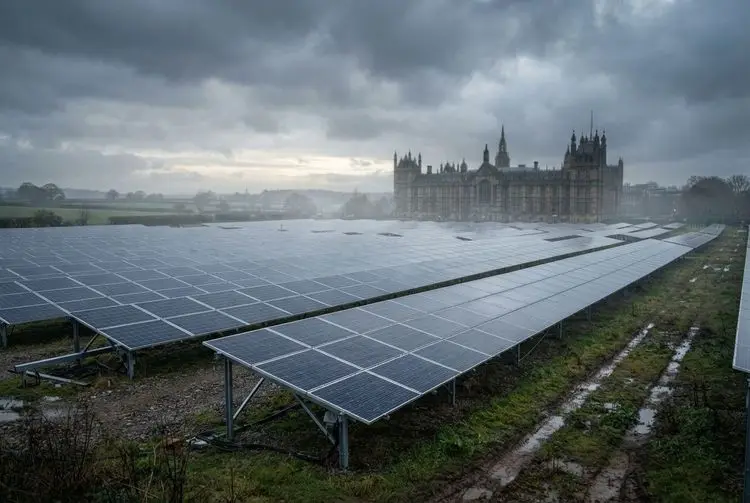
The UK government has paused the next Contracts for Difference (CfD) auction round, leaving solar developers to navigate an unusually long timeline before the current allocation round concludes. Energy minister Michael Shanks announced the decision to delay the start of AR9, telling the House of Lords Environment and Climate Change Committee that the government wants to review the CfD scheme before proceeding further.
"We do now want to pause before AR9 and look at whether we need some more significant changes to the contracts for different scheme to make sure they work for the consumers of the country," Shanks said. The minister stressed that the pause is a reform measure, not a retreat from net zero targets, despite media reports — notably in The Telegraph — that framed it as a "climbdown."
AR8 results are now due in February 2027, the longest timeline permitted under the current framework. Since Allocation Round 4 (AR4), CfD rounds have taken place on a yearly basis. The extended gap between AR8 and AR9 means developers are facing a period of substantial uncertainty.
Solar's strong track record under CfD
The CfD mechanism has played a central role in the UK's solar expansion. Over the last three years, 60 percent of all solar photovoltaic capacity built in the country received support through a CfD contract. That figure underscores how deeply the sector has come to rely on the scheme for investment certainty.
Crucially, the CfD is not a pure subsidy in the traditional sense. Generators are remunerated through consumer energy bills, and when wholesale electricity prices rise above the agreed contract price, developers must pay the difference back. Over the last decade, UK solar farms have paid back £26.3 million more to consumers than they have received under the CfD mechanism. The net payback figure demonstrates that solar has delivered value to bill payers even as it benefited from guaranteed revenue floors.
What the pause means for developers
For the solar industry, the immediate concern centres on AR8 itself. With AR9 paused, the upcoming round takes on heightened importance.
"For developers, the immediate implication is that AR8 may be the last opportunity to secure a CfD for some time, with the next auction potentially looking quite different," said Sam Hollister of LCP Delta.
Angus Widdowson of SmartestEnergy said the decision "will come as a blow to generators and puts the future of the energy transition into question." The sentiment reflects the unease among project developers who had banked on a steady sequence of annual auctions to underwrite their project pipelines.
Industry experts have warned that the extended timeline could make AR8 "intense" as a larger-than-usual pool of projects competes for a limited set of contracts. Developers who miss out may face a multi-year wait before the reformed CfD scheme reopens.
Grid infrastructure as the bottleneck
A key reason for the pause is grid readiness. The government has acknowledged that a large share of the physical grid infrastructure needed to connect new generation capacity does not yet exist. Reinforcements must be in place before further CfD rounds can meaningfully expand capacity, Shanks indicated.
Chancellor John Healey has said consumer cost is the first consideration in energy policy. The government's stated focus remains on delivering cheap energy through clean power, but the current gap between generation ambition and grid reality is forcing a tactical slowdown.
Outlook and next steps
The Low Carbon Contracts Company (LCCC) will administer AR8 with results now expected in February 2027. The reformed AR9 framework — whatever it looks like — will not begin until after that point. Dan Roberts of Frontier Economics, Adam Bell of PF Global and Richard Howard of Aurora have all been cited as analysts watching the CfD reform process closely.
For solar developers, the key question is what "significant changes" Shanks and his team will introduce. Whether the reformed contracts include adjustments to strike prices, contract durations or eligibility criteria remains unknown. Solar Energy UK has yet to issue a detailed response to the announcement.
What is clear is that the annual cadence of CfD rounds that the industry has relied on since AR4 is breaking. Solar developers now face a longer, more competitive path to securing the revenue certainty that CfD contracts provide. The next two years will test whether the UK solar market can sustain its recent growth momentum without a steady pipeline of CfD-backed projects.