
Tax Credit Deadline Drives Solar Project Changes as US Capacity Hits 100 GW
Federal tax credit expiration reshapes project decisions while US solar manufacturing crosses a major milestone.
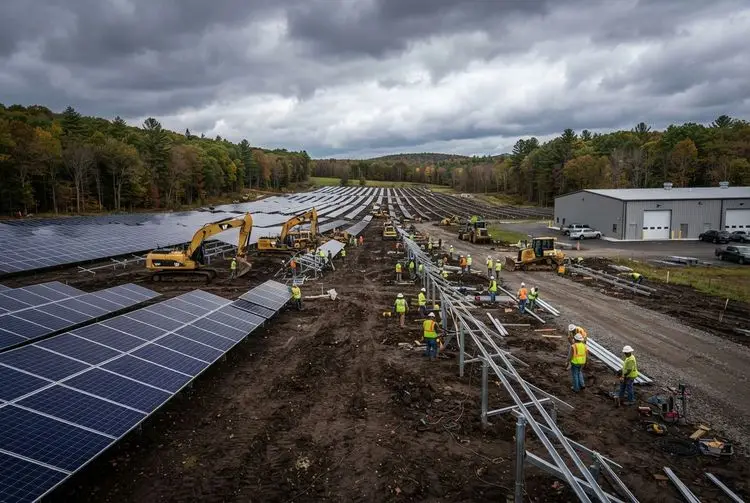
The approaching expiration of key federal tax credits is forcing project developers across the U.S. solar sector to rethink timelines and scope, even as domestic manufacturing capacity crosses the 100 GW threshold and new analysis quantifies the billions of dollars solar and storage saved this summer.
In St. Lawrence County, New York, a 20-megawatt battery storage component has been removed from the proposed 240-megawatt Rich Road Solar project in Canton. The New York Power Authority recently acquired split ownership of the facility alongside French renewable energy company EDF Power Solutions.
A NYPA official told North Country Public Radio that the battery was "removed in an effort to streamline the project timeline and help ensure it can take advantage of sunsetting key federal tax credits." The decision illustrates how federal incentive deadlines are directly influencing project design and scheduling decisions for developments still in the pipeline.
The battery removal also sidesteps a contentious local issue. Battery storage systems have raised safety concerns in the region after a battery caught fire at a solar farm in neighboring Jefferson County a few years ago. Construction of the solar panels is expected to begin late next year.
Domestic Manufacturing Crosses 100 GW Milestone
On the manufacturing side, U.S. domestic solar production capacity has surpassed 100 GW, according to reporting from pv magazine USA. Industry leaders gathered at pv magazine USA Week 2026 addressed the hard realities of executing profitability at scale, including workforce training, upstream cell integration, and navigating evolving trade policies.
The milestone reflects a significant buildout of domestic production capacity. However, the industry conversation has shifted from capacity announcements toward operational execution — how to run those factories profitably and staff them with trained workers.
Solar and Storage Deliver Billions in Summer Savings
A new analysis highlighted by pv magazine USA shows that solar and storage saved California USD 2.5 billion and Texas USD 3.5 billion this summer. The savings came as record electricity demand was met at sharply lower wholesale prices across America's two largest energy markets.
The findings underscore the grid-level value of solar and storage during peak demand periods. However, the same analysis notes that utility transmission and distribution grid charges keep residential electricity prices high, meaning consumers may not see those wholesale savings reflected in their bills.
Industry Coalition Opposes Dominion-NextEra Merger
A solar industry coalition is opposing the proposed USD 67 billion merger between Dominion and NextEra as currently structured. Solar and storage industry groups are calling for interconnection reforms as conditions of the merger's approval, arguing that the deal could create additional barriers for residential solar and battery installations.
The opposition reflects broader industry concerns that consolidation among utilities could complicate interconnection processes that are already a bottleneck for residential solar and storage deployment.
Mixed Q3 Earnings Reflect Diverging Market Segments
Third-quarter earnings from four major U.S. clean energy companies were mixed, reflecting booming demand for utility-scale equipment and grid storage alongside a struggling residential solar market hampered by the loss of federal tax credits.
According to a pv magazine USA earnings roundup, Corning grew, Enphase stumbled, Tesla was on autopilot, and Nextpower set records. The results illustrate a widening gap between the utility-scale and grid-storage segments, which benefit from strong demand, and the residential segment, which continues to face headwinds from the expiration of federal tax credits.
Common Threads Across the Market
Across both the utility-scale and residential segments, the expiration of federal tax credits emerges as a central force shaping market dynamics. In Canton, the credit timeline directly drove the decision to drop battery storage from a utility-scale project. Nationally, the loss of federal tax credits is cited as a key factor in the residential solar market's struggles, even as utility-scale and storage demand booms.
The developments also reflect different vantage points on battery storage. The North Country Public Radio report emphasizes local controversy and safety concerns, citing the prior battery fire in Jefferson County. The pv magazine USA coverage treats storage as a growing market segment, highlighting grid-scale savings and consumer product testing, while noting that interconnection barriers could hinder residential battery installations.
Both sources point to the same underlying dynamic: policy and regulatory decisions — tax credit timelines, merger conditions, interconnection rules — are actively shaping where and how solar and storage projects move forward.
What to Watch
Construction of the Rich Road Solar project's panels is expected to start late next year, with the battery component no longer part of the plan. The Dominion-NextEra merger will continue to draw scrutiny from solar and storage groups seeking interconnection reforms as conditions of approval. The residential solar market's recovery will depend in part on how companies adapt to the loss of federal tax credits, even as utility-scale manufacturing and deployment reach new highs.
For industry professionals, the week's developments underscore a market increasingly split between a thriving utility-scale and storage segment and a residential segment under pressure — with federal tax credit timelines acting as a decisive factor in project planning on both sides.